Snowflakes Are Dancing

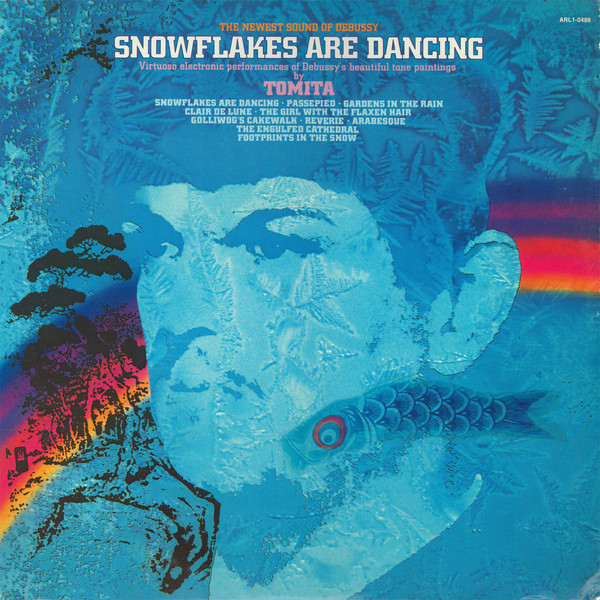
It snowed in northern Wisconsin recently.  A bit unusual for mid-May, but not entirely unheard of.  I couldn’t help thinking those snowflakes, swirling in the chilly air, were dancing in tribute to yet another fallen artist.  Isao Tomita was a Moog synthesizer virtuoso who died at the age of 84 on May 11, 2016.  Forty-two years ago I was introduced to what became his most famous work.
Snowflakes Are Dancing

Snowflakes Are Dancing was an album of Claude Debussy’s “tone paintings” interpreted by Tomita on the Moog.  It wasn’t the first album of electronic music I’d heard.  Just before graduating high school, I was flipping through the “Psychedelic” bin in the record section of a local department store one day, searching for some unconventional music.  (I was already a fan of the Mothers of Invention.)  A shiny, silver cover bearing the title Silver Apples grabbed my attention.  It was recorded by a duo bearing that name and has since been cited as the first collection of experimental electronic music.

I plunked down a couple bucks and brought it home for a trial listen.  At first I didn’t care much for the pulsating, sometimes discordant, driving beat of synthesized sounds.  Nonetheless, I continued to play it occasionally just to hear something different.  Until my freshman year in college.  It was then the album was sold along with some others in what would be the first of several record purges over the next few years.  How much I regret purging some of those albums is a story for another time.

Most of my college listening (and occasional performing) involved serious folk-rock music, much of which carried with it a message of protest.  But a spark of interest in the strange and exotic sound of electronica was rekindled after college, fueled in part by movie soundtracks like A Clockwork Orange.  The film featured works performed on the Moog synthesizer by Walter Carlos.  (Later he became Wendy Carlos.)  Carlos had already gained notoriety with his 1968 Grammy-winning album, Switched On Bach, a collection of music by Johann Sebastian Bach played on the Moog.  He composed the electronic music for A Clockwork Orange three years later.

I picked up both albums and shortly after that acquisition, purloined one track from Switched On Bach to use as background music for a National Library Week promotional film I co-produced in the mid-seventies.  It featured card catalog drawers opening and closing on their own, created with stop-action animation effects that appeared to be in sync with the music.  The spot aired for a brief time on local cable television.  I wish I knew whatever became of it.

In the meantime, on November 2, 1973, I attended my first Moog synthesizer concert, promoted as a “multimedia performance of light, film and synthesized music.”  The soloist was Morton Subotnick, whose press kit highlighted his contribution of electronic effects for the soundtrack to 2001: A Space Odyssey.   It turns out my expectations were fulfilled neither in sight nor sound.  2001: A Space Odyssey it definitely was not.

A few months after that concert, undaunted by my disappointment with Subotnick’s performance, I acquired Tomita’s Snowflakes Are Dancing album. The atmospheric interpretations of Debussy’s works blew me away.  I loaned it to an amateur filmmaker friend who used it as the soundtrack to a short work he entered in an international film festival.  He had cast me in the lead role, so it was the least I could do in return.  After that, I played the LP until it wore out.  For years I’d be reminded of Tomita upon hearing a Moog synth in prog rock music.  Lucky Man, by Emerson, Lake and Palmer, for example.

Only recently did Snowflakes Are Dancing rejoin my playlist after noticing the recording among a listing of digital titles available online.  Who would have thought the electronic music produced forty-two years ago is now downloaded electronically and paid for electronically as well?  Far out!

Perhaps those late snowflakes in northern Wisconsin were dancing for Isao Tomita, who forever left his footprints in the snow and his fingerprints on the Moog.


Statistics, More Statistics and Cover Versions

My friend and neighbor, Caryl (Home Sweet Abbey), sent me an article from Chart Attack, a Canadian music publication, titled Old Music is Outselling New Music for the First Time in History.  The piece was published online January 20, 2016 and cites A.C. Nielsen’s annual year end music sales report for 2015 compared to 2014.  For the first time in music sales history, albums released more than 18 months ago outsold current releases by more more than four million copies.  It’s important to note this phenomenon involved physical album sales.  Digital sales of current album releases were still slightly ahead, but individual track sales were predominantly “oldies,” which now defines music more than 18 months old.  Among other things, the author cited another Nielsen report stating that “Pink Floyd’s Dark Side of the Moon sold 50,000 records this past year, the third highest selling album on vinyl.”

Digging for more information on this topic (and stretching an analogy), I determined the article cited above is a “cover version” of a previous report.  Let me explain.

On Stereogum, a daily Internet publication focusing on music news, there was an article titled Old Albums Outselling New Albums For The First Time Ever published way back on July 19, 2012 by a different author who cites similar Nielsen statistics.  Dark Side of the Moon is also mentioned as a big seller in this piece, and both articles use Pink Floyd’s album cover as the primary graphic.  But what’s interesting is that in spite of nearly fours years separating publication of these two articles, each claims the same phenomenon to have occurred for the “first time.”  The earlier date of this article might distinguish it as the “original version.”

Yet another author covered the topic in greater detail on a UK Internet website, Music Business Worldwide, titled ‘Old’ Albums Now Outsell New Albums on iTunes in America on January 29, 2015.  In its extensive sales analysis, this article examined declining physical record sales when compared to digital download sales.  Interestingly, the author points out the difference between the 2012 stats, for which “oldies” sales were only a momentary blip, and 2015 stats, which showed a full year trend.  Instead of Pink Floyd, he chose Bob Marley’s classic Legend album for the main graphic.  Apparently, Legend was the fifth biggest-selling vinyl album of 2014 in the U.S.  Let’s say this “cover” article is analogous to Eric Clapton’s soft-rock cover of Marley’s reggae song I Shot the Sheriff.  Clapton’s version captured Grammy Hall of Fame honors.

Finally, on January 25, 2016 a fourth author who, after only a five day waiting period, used the same title as the first article mentioned above, Old Music Outselling New Music For First Time in History, took a completely different approach, essentially offering an opinion which, in a nutshell, was “new music sucks.” That pretty much summed it up.  The online publication, Western Voices World News, isn’t devoted solely to music, which perhaps made a difference in the depth of analysis.  This particular “cover version” might be comparable to keeping the same song title, but using kazoos instead of voices to replace the lyrics.

Searching around, I found several other “covers” of the same article. Fortunately, I was listening to the radio during this investigation and heard some surprising cover versions of old songs breathed new life by contemporary bands. The first was Little Honda, a 1964 Beach Boys tune (first covered by the Hondells) more recently covered by Yo La Tengo.  Next was the 1964 Grammy winning, country-pop novelty song that I never really liked much, Dang Me by Roger Miller, brilliantly covered by alternative country artist, Buddy Miller (no relation).  A wonderful band called Whitehorse just released an EP with a sultry cover of Chuck Berry’s 1964 Nadine.  And in just the past hour, I heard Laura Love do justice to the memory of Kurt Cobain, covering his 1992 Nirvana composition Come As You Are.  Not two minutes after that, it was Sly & the Family Stone’s 1969 Thank You for Letting Me Be Myself Again recorded in 1970 by jazz saxophonist Maceo Parker & All the King’s Men.

One thing is certain.  The lines of music sales graphs start to blur slightly when we discuss what’s old and what’s new and what’s selling right now.  But when you listen to those songs on the radio, it doesn’t really matter.  After 18 months they’re all considered oldies anyway.

stockphoto_Sales_Chart

Purple Reign

It was sad news to hear about the passing of Prince, yet another music icon to die in the past year or so who had a major impact on pop music.  I was a fan of Purple Rain, even to the point of recently learning to play an acoustic guitar arrangement of the song.

All the purple-tinted condolence photos, musical tributes by artists drenched in purple stage lighting, and articles mentioning one purple thing or another got me thinking.  How much music has been influenced by the color purple?

Well, the first thing that comes to mind is the novelty song Purple People Eater by Sheb Wooley.  It was a number one hit in 1958.  I always thought the “eater” was purple, but years later, after careful analysis of the lyrics, the creature himself may not be purple at all.  The creature says that “eating purple people… sure is fine.”  Then I guess most of us are safe, unless we hold our breath too long.

One of my sixties guitar heroes was Jimi Hendrix.  Upon hearing Purple Haze for the first time, I was immediately addicted to his music.  “Lately, things don’t seem the same…” is a mantra oft repeated in my brain since college graduation.

I heard Nino Tempo and April Stevens croon the song Deep Purple back in 1963.  That song was intended to be the B-side of Tempo and Stevens’ single titled I’ve Been Carrying A Torch For You So Long That It Burned A Great Big Hole In My Heart, which had the distinction of being the world’s longest song title.  Ironically, that distinction was purloined by Prince himself in 1984, whose B-side of When Doves Cry was titled 17 Days (the rain will come down, then U will have 2 choose, if U believe, look 2 the dawn and U shall never lose).  Whew!  Both lengthy titles were rivaled by the 1961 Ray Stevens song, Jeremiah Peabody’s Polyunsaturated, Quick Dissolving, Fast Acting, Pleasant Tasting Green and Purple Pills, that even contains the word “purple” in its title.

The other “Deep Purple” was the name of an English rock band whose 1968 album, The Book of Taliesyn, is the only recording of theirs I ever owned, four years before Smoke on the Water became a huge hit for them.

Now if I were to really stretch things, I might mention Moby Grape, a great San Francisco band from the late sixties whose only connection to the word purple is in the “grape” part of their name.  However, if I go down that road, I’d probably need to pour myself another glass of wine.  And though it would say red on the label, it would be purple in my glass… and hazy in my brain.

So for now, When the deep purple falls over sleepy garden walls, it’s time for bed.

self-1 purple


Pass the Wavy Gravy, please.

After I’d imagined myself as the next international rock star, only to have those hopes smacked down by reality, I moved on.  If only I’d moved in a slightly different direction, I might have ended up behind a microphone doing something other than speaking to yawning audiences of professional colleagues, expounding on topics of grave interest to my fellow librarians.

“You know, VisiCalc* will soon become the tool we use to manage entire library budgets and expenditures.” I’d prophesize from the podium.  Another gem was, “BITNET** is going to revolutionize the way we exchange information.”  Who knew I was such a prodigious prognosticator?

What I would rather have been doing during those speeches was spinning some records and talking about the bands whose songs I was playing.  So, it’s no surprise that sometime between the introduction of VisiCalc and the unleashing of the Internet, I’d submit my name to a local radio station contest in hopes of being selected to guest DJ a three-hour “classic rock” program.  Contestants were asked to submit a short list of songs they proposed to play.   To my surprise and delight, I was selected.  The person who called, suggested bringing enough music on vinyl or CD to fill three hours.  Counting commercial breaks, station IDs, local news and weather reports, it amounted to what seemed like only twenty minutes, though I’m sure it was quite a lot more.

On a crisp Saturday morning in October 1989, I was the guest DJ on that classic rock radio station in La Crosse, Wisconsin.  I brought along a crate load of LPs and CDs containing twenty-year old music to play and chat about on air with the show’s host.   About an hour into the program and much to my surprise, Wavy Gravy walked into the studio.  Wavy, whose real name is Hugh Romney, was the iconic “Hog Farm” operator at the Woodstock Music & Arts Festival in 1969.  A perpetual peace activist and counterculture clown, he had performed a stand-up show the previous night at the city’s fine arts venue, the Pump House.

The host interviewed him while while I contributed an occasional meaningless comment.  When the interview ended, I shook his hand and asked for an autograph.  Searching around for something on which to do the honor, Wavy spotted my Jimi Hendrix CD, Are You Experienced?   He grabbed it off the console, pulled out the cover insert and scribbled this on the back of it:

891014 Wavy Gravy autograph copyIt says, “‘Scuze me while I kiss the sky” and is signed “Wavy G.”  After he left the studio and we queued up another song, my host asked if I’d been to Wavy’s show the night before.  Embarrassingly, I had to respond that I hadn’t.  He smiled and then explained why Wavy chose those words from the song Purple Haze.  During one part of his act, when he was describing Jimi Hendrix’s early morning performance at Woodstock, he stepped in front of a loudspeaker, accidentally causing a couple seconds of screeching feedback.  He paused, looked up toward the rafters and uttered, “‘Scuze me while I kiss the sky,” resulting in wild cheers and applause from the audience.

Now, whenever I hear a Jimi Hendrix song, I think of meeting Wavy Gravy and wonder how in the world I was lucky enough to capture a personal moment with him.  I chalk it up to experience.  Mainly the one I missed.

“But first, are you experienced?  Have you ever been experienced?  Well, I have.” –Jimi Hendrix, Are You Experienced?

_________________________
*VisiCalc was the first spreadsheet computer program for personal computers, originally released for the Apple II. It is often considered the application that turned the microcomputer from a hobby for computer enthusiasts into a serious business tool, prompting IBM to introduce the IBM PC two years later. VisiCalc is considered the Apple II’s killer app. It sold over 700,000 copies in six years, and as many as 1 million copies over its history. (Wikipedia)

**BITNET was an early world leader in network communications for the research and education communities, and helped lay the groundwork for the subsequent introduction of the Internet, especially outside the US. (livinginternet.com)


Merle, Mozart and Me

I’m not what you’d call an avid country music fan.  Nor would I consider myself to be an opera expert.  The thing is, I like some country music.  I mean real country music — George Jones, Johnny Cash, Patsy Cline, Willie Nelson — not the pop music stuff that’s widely heard now.  (I don’t believe Taylor Swift is a country singer.)   I also enjoy some opera.  I prefer what’s called “bel canto,” Italian for “beautiful singing.”

My uncle was the first person I knew with a high-quality component stereo system comprised of an Acoustic Research (AR) turntable, a pair of AR speakers and a Sherwood receiver.  (I think it was a Sherwood.)  He was, and still is, a classical music aficionado.  Other than the occasional Maria Callas or Beverly Sills appearance on the Ed Sullivan Show, my exposure to opera and classical music in general had been limited at best.  My uncle Gaspare introduced me to the soaring dynamics of symphonic music and opera on that audio system.

But I was a mere teenager and my main musical interest gravitated to rock ‘n’ roll, thanks in part to a birthday present of a transistor radio that pulled in WLS in a scratchy-sounding way.  Sometimes I’d hear a country and western song that sounded pretty good, but I’d never admit it to my friends.  Likewise, I’d hear some version of Sabre Dance or Flight of the Bumble Bee and find out later it was really a classical music piece often used as background music by an acrobat or a juggler on TV.

One Merle Haggard song I recall hearing was performed by the Grateful Dead.  It wasn’t until I read the song credits on their live “Skull and Roses” album that I learned Mama Tried was Merle’s song.  That was when I first recognized “crossover” music — songs originating in one genre and becoming popular in another.  Years before, I’d heard Johnny Cash’s Ring of Fire on top-forty radio without making that crossover connection.  With Merle Haggard’s recent death, I was reminded of his songs I liked, including Today I Started Loving You Again, Mama’s Hungry Eyes and Mama Tried.

What does this have to do with Mozart?  The honest answer is — not much.  Except, all songs tell a story.  Stories of love, work and play, and of trials, gains and losses.  Opera is no different.  This past week, we attended a performance of Mozart’s opera, The Magic Flute.  It was sung in German, but there were projected English supertitles.  A far cry from the simple poetry and three-chord progression of country and western music, the more complex orchestral score and voices ranging from a sonorous baritone to a lilting soprano portrayed the same sentimental stories of searching for love and other tribulations, just in a more flamboyant way.

How fantastic would it be to slip the song Today I Started Loving You Again into the plot of an opera like The Magic Flute?  Or perhaps envision old Merle belting out Ein Mädchen oder Weibchen (A Girl or a Woman) during a set on the Ryman Auditorium stage?  Yeah, I guess either scenario would be pretty much out of the question.  But from a purely show biz perspective, a country singer with a black cowboy hat slung low toward his tinted glasses holding a guitar isn’t that far removed from an opera singer in a feathered headdress and mask holding a magic flute, is it?

Dalton Youth Center, Summer 1968

The tension was palpable as I stepped out of my dad’s Studebaker and walked toward the double glass doors of a building that looked more like a church than a teen center.  I’d already flicked my Winston cigarette butt through a rolled down window before pulling into the parking lot.  The sheet of paper I was clutching, a partially completed, standard musicians contract, caught the warm summer breeze and fluttered in my hand.  The guy in the brown suit and coke bottle glasses standing inside those doors was director of the Dalton Youth Center.  His name has been erased from my memory, probably the better for both of us.  We hadn’t yet agreed on a dollar amount for the gig he wanted my band to play there.

It was “my band,” because I was the one with a pad of blank contract forms.  We called ourselves “Volume One,” named after a bookstore in Piper’s Alley off of Wells Street in Old Town Chicago.

When the No Left Turns broke up just after the new year, I joined rival band, the Jaywalkers, along with Bruce, our drummer.  The Jaywalkers had just lost their drummer, Dick, to our other rival band, the Marauders.  Dick had also been the lead vocalist.  Suddenly we’d all become free agents.  So Bruce drove the tempo and I took over the vocals for the Jaywalkers.

The new Jaywalkers played some pretty good gigs before two things happened.  Stan, the lead guitarist, left to join the Marauders.  They were certainly living up to their name.  About that time I became more involved in the high school musical, West Side Story, so play rehearsals were impinging on band rehearsals .  Upon announcing I couldn’t play any gigs over the next few weekends, Bruce threw down his sticks and abruptly quit, exclaiming “This is bullshit!”  That was the end of the Jaywalkers and the last I ever saw of Bruce.

With the musical and graduation finally behind us, ex-Jaywalkers Mike, Dean and I wanted to play more music during that summer.  We recruited ex-No Left Turns Tony, for lead guitar.  Then another classmate named Joe, who played trumpet and could sing harmony joined up.  Searching for a drummer, we learned that Dick (remember Dick?)  had been “released” by the Marauders.  So we asked him to join us.  Now we numbered six, and four of us could alternate singing lead and harmonizing.  Mike played rhythm guitar and organ, Dean played bass.  Two Joes now fronted the band.  And thus, Volume One was born.  We played four gigs that summer.  Dalton Youth Center was the first.

The brown-suited guy met me inside the double doors.  We exchanged greetings and he invited me to his office where I sat across from him.  Leaning back in his executive chair, he put his brown wingtips up on the desk, crossed at the ankles, and explained the gig.  He wanted a “break band” to play between sets of the One-Eyed Jacks from Chicago, the night’s headliners.  I told him we needed a hundred and fifty dollars to play three break sets.  He laughed and counter-offered an even hundred.  Thinking out loud, I said, “Look, we have six guys in the band and that’s not even twenty bucks apiece.”
“Oh,” he grinned.  “If you want twenty each, then let’s make it a hundred and twenty bucks.’
Realizing my next counter offer of thirty dollars each times six would be more than what I’d initially proposed, I quickly agreed.

We shook hands, completed the contract and signed it.  I kept the original and handed him the carbon copy.  Leading me out of his office and into the dance hall, he pointed up to the balcony and said, “That’s where you guys will set up and play from.”  Having recently graduated from high school, I was compelled to correct his grammar and advise him not to end a sentence with a preposition, but I held my tongue.  It was a bit discouraging to discover we’d be lugging our gear up a flight of steps and setting up there just to play three, twenty-minute sets.  On the other hand, we didn’t know many songs.  So it all evened out.

On the night of the gig, we arrived early to carry our stuff up to the balcony and tune up.  Then we watched as the One-Eyed Jacks set up and tuned.  Before kicking it off, they invited us to compare set lists.  After a brief discussion they instructed us not to play Purple Haze and Sunshine of Your Love because those were songs in their sets.  Reluctantly, and a bit annoyed, we agreed.

The One-Eyed Jacks were pretty damned good that night.  They even played Good Vibrations, the only band other than the Beach Boys I’ve ever heard play that song to this day.  But their versions of Purple Haze and Sunshine of Your Love were no better than ours.  That was the message our seriously bruised egos were transmitting to our ears.  Given that we probably would never share another venue with the One-Eyed Jacks, we sneaked both songs into our last set, finishing with a blistering Purple Haze, overladen with fuzz tone and wah-wah effects.

Volume One never heard any more from the One-Eyed Jacks.  We broke down our equipment, carried it out to our vehicles and convoyed over to the Hollywood Drive-In to spend some of that twenty dollars each on fish and chips dinners.  By the way, the guy in the brown suit thought we were “pretty good.”  So did we.

Rockin’ My Valentine

Quick!  Name your top ten favorite rock ‘n’ roll love songs.  Got ’em?  Okay, here’s my list.  Not in any particular order.  It’s a mix of sad and happy (sappy?), rock and soul, mostly dusty old tunes.

1.  God Only Knows – The Beach Boys.  I truly believe in my heart this is among the best songs ever written. Period.  “I may not always love you.  But long as there are stars above you, you never need to doubt it.  I’ll make you so sure about it.  God only knows what I’d be without you.”  I rest my case.

2.  Crying – Roy Orbsion.  A masterpiece of pure melancholy.  This guy runs into an old flame and it stirs up a firestorm of emotions in his still broken heart.  “Yes, now you’re gone and from this moment on, I’ll be crying, crying, crying, crying.  Yeah crying, crying, over you.”  Holy crescendo, Batman!  By the way, Rebekah Del Rio’s cover of Crying (Llorando) from David Lynch’s film Mulholland Drive is hauntingly awesome.

3.  Something – The Beatles.  From the moment the Beatles sang Love Me Do until their 1970 breakup, they were all about love.  Nothing bearing the Lennon/McCartney writing credit quite matches up to George Harrison’s heartfelt homage to his wife, Patti Boyd.  Not even Yesterday.  Just my humble opinion.  “Something in the way she moves attracts me like no other lover…

4.  Wild Horses – The Rolling Stones.  Maybe they didn’t get much satisfaction, but when they did, they didn’t want to let it go.  And this song is a reflection of that and so much more.  “Wild horses couldn’t drag me away.  Wild, wild horses.  We’ll ride them someday…”  You can almost feel those horses pulling on your heartstrings.

5.  In Your Eyes – Peter Gabriel.  If eyes are the gateway to your soul, then this song is the gateway to your heart.  I  prefer the eleven minute live version on his Secret World Live album.  “In your eyes I see the light, the heat in your eyes.  Oh, I want to be that complete.  I want to touch the light, the heat I see in your eyes…”  The Jeffrey Gaines acoustic cover of In Your Eyes is a masterpiece to behold.

6.  I Want You – Bob Dylan.  I confess to having an affair of the heart with Dylan and his music.  In a recent commercial, “Your major themes are time passes and love fades,” IBM’s artificial intelligence software dubbed Watson tells Bob after a computer analysis of his songs.  “I want you.  I want you.  I want you, so bad.  Honey, I want you.”  Blonde On Blonde contains the definitive version, but the oft-scorned Bob Dylan at Budokan interpretation reveals a wistful Dylan accompanied only by ethereal flute and organ.

7.  Moondance – Van Morrison.  “Van the Man” captures the perfect autumn evening, perhaps with a campfire and a shared bottle of Pinot Noir.  I know.  I’ve been there.  Guitar in hand, serenading my sweetheart.  She knows.  She wouldn’t let me forget.  “It’s a marvelous night… Can I just have one more moon dance with you, my love?  Can I just make some more romance with you, my love?

8.  My Girl – The Temptations.  One of the great prom songs.  Just about every garage band I knew played their hearts out on My Girl.  Some even tried to copy the Temptations’ choreography.  Most failed.  “I’ve got all the riches, baby, that one man can claim.  I guess you’d say, what can make me feel this way?  My girl.  Talkin’ ’bout my girl.

9. All I Have To Do Is Dream – The Everly Brothers.  A guilty pleasure shared between my sweetheart and me.  Oh, those long days and weeks between our rendezvous.  “When I want you in my arms.  When I want you and all your charms.  Whenever I want you, all I have to do is dream.  Dream, dream, dream.”  Living two hundred miles apart can leave you dreaming your life away.

10.  Let’s Stay Together – Al Green.  Arguably the last of the great soul singers, Al Green transforms any cozy evening in front of a warm, glowing fireplace into a romantic tryst in Paris.  When no one else can warm your heart, Al can.  “Ooh, baby.  Let’s, let’s stay together.  Loving you whether times are good or bad, happy or sad.”  Years after the original version, Tina Turner made it her own as well.  Al and Tina.  Ooh, baby…

❤️  What are your favorite love songs?  ❤️


Masters of Mardi Gras

To most folks, New Orleans naturally comes to mind as Mardi Gras approaches.  To be immersed in a carnival of such profound excess must be something undoubtedly special.  However, I confess to having only experienced that celebration vicariously as a viewer of the nightly news whenever Fat Tuesday rolls around each year.  The New Year’s Eve that Sylvia and I celebrated in New Orleans with some friends years ago was great fun, but probably nothing like my imagined Mardi Gras parade where drunken revelers tear at their clothes and flail around in a Bacchanalian snake dance, strings of brightly colored beads flying everywhere.

For a while in the early sixties, my hometown Catholic high school would sponsor a “Mardi Gras” annual fundraiser.  Beloit Catholic High bore little resemblance to New Orleans.  The school gym, decorated in festive ribbons of crepe paper, featured an array of booths, each containing a cheesy carnival game like one you might have played at a country fair in the previous century.  Food and baked goods were both sold and offered up as prizes.  I remember parading around in a “cakewalk,” dutifully attempting to win some homemade sweets, confident my quarter entrance fee would positively impact the bottom line of the high school I’d be entering one day.

Mardi Gras wouldn’t be worth a hill of baked goods without music.  But it wasn’t the saints marching in for this event.  (Actual saints marching into a Catholic school would have been very cool, though.)  Instead, I heard a band playing rock ‘n’ roll as I wandered down the hallway toward a large classroom that served as the school’s sole study hall.  I wanted to be in that number.  The room was packed, not with wild Bacchanalian revelers, but with mostly tame high school kids doing the twist.  I paused for a second in the doorway, nodded to a couple of classmates from my grade school, then strode briskly to the front of a makeshift bandstand on which stood four guys in matching ties and vests, totally rocking out on two guitars, a bass, and drums.

MicsMasters0008

They were Mic’s Masters and they were deep into an instrumental number I didn’t recognize.  Three of them were swinging their guitar necks back and forth in time to the music.  All at once, they broke into synchronized footwork that got them moving left to right and back again, wailing guitars swinging along with them.  It was an impressive display of showmanship and one to which I immediately aspired.

I stood there mesmerized, listening to their set that included a spot-on cover of the Rivingtons’ Papa-Oom-Mow-Mow and some instrumentals that showed off their guitar chops.  Mic’s Masters were the first rock ‘n’ roll band from Beloit to record in a small, private studio north of town and release a 45-rpm record containing two instrumentals.  The A-side was a cover of Sandstorm by Johnny & the Hurricanes.  The B-side, though, was their own composition, Rock-n-Round.  Either would conjure up images of surfing in California over carousing in Louisiana.

I won’t be parading through the French Quarter, carousing to the music of Professor Longhair or C.J. Chenier on Fat Tuesday this year either.  Even if I was, the image of twisting to Mic’s Masters at that small-town fundraiser would remain indelibly etched in my mind.  Beads or no beads, Bourbon Street or Beloit, you can bet I’ll let the good times (rock and) roll on Mardi Gras.  Laissez les bons temps rouler!

(Special thanks to Jean Voss for graciously providing the Mic’s Masters memorabilia.  Click on “Rock-n-Round” above for the full effect.)

Fly Jefferson Airplane…

A founding member of Jefferson Airplane made his final departure today.  I was a high school junior when Somebody to Love and White Rabbit hit the airwaves.  My band, the No Left Turns, never learned either song, probably because we harbored some deep-seated machismo over whether a guy could/should sing a tune sung by a girl.  This, in spite of the fact we once tried learning Stop! In the Name of Love by the Supremes.  We gave up on that one and likely swore off any further attempt to learn “girl group” songs.  That was mistake number one.  In the meantime, our rivals, the Jaywalkers, did a fine job on White Rabbit which made me quite envious.  Their drummer sang it, a guy whose voice could reach notes several steps higher than mine.

Jefferson Airplane’s songs stuck with me through college.  Some of their music, particularly their Volunteers album, was an inspiration to those of us who openly opposed the Vietnam War and the wholesale conscription of friends my age to fight it.  Guess I was just one of those “effete college snobs” referred to by Spiro Agnew.

I had two chances to hear Jefferson Airplane perform in concert.  The first was practically in my backyard at Beloit College in July 1967.  My excuse for missing it?   I have none that I can recall.  It was a Sunday night show.  What could I possibly have been doing otherwise on a Sunday night in Beloit?  That was mistake number two.

670624 RkfdRegRep AirplaneThe next time I had an opportunity to hear the Airplane live was sometime in the fog of my senior year in college when I thought better of joining a carload of friends planning a roadtrip to another state to see them.  I use the term “planning” quite loosely here.  I’d already experienced one of those loosely planned roadtrips to a rock festival in Wisconsin prior to that.  So I had firsthand knowledge coupled with some practical experience concerning such roadtrips.  I declined this invitation.  Mistake number three?  Perhaps.

It ends up that I never saw one of my favorite bands in concert.  Just a couple of years ago I discovered my Jefferson Airplane vinyl albums were no longer playable.  I replaced them with iTunes downloads and still listen to them to this day.  In fact, I’m listening to Crown of Creation right now.  Bon voyage, Paul Kantner.  I hope you reached your final destination peacefully.

The Trailer

The No Left Turns traveled in style.  Well, perhaps not at first.  As the amount of equipment we lugged around continued to grow, it became harder and harder to get all of it to gigs in fewer than three cars.  Unlike today’s SUVs, pickup trucks and crossovers, the typical family car back then was a sedan.  And while station wagons were popular, Dad traded in our family’s DeSoto wagon, a purple and white two-tone beast, for a shiny blue Pontiac Catalina sedan.  Not inclined to entrust the new family car to me and my bandmates, I was offered the use of his work car, a Studebaker Lark.  It was a cream white, two-door model with a standard shift on the column.  Cool!  I could just about fit all my stuff and half of my cousin’s stuff into it.  The other half of Mike’s gear and everything else were left to fate.

Sometime around the fall of ’66, Mike’s dad acquired a trailer frame.  It started out as just a plain old steel frame with two wheels and a tongue, but Uncle Bob transformed that hunk of metal and rubber into one magnificent hauling vehicle.  First, he constructed a plywood enclosure to mount on it, three solid sides and a roof.  He included a set of hinged double doors on the back end that opened out for loading, and closed with a hasp and padlock to keep them shut while hauling gear around.  Then he painted the entire thing jet black.

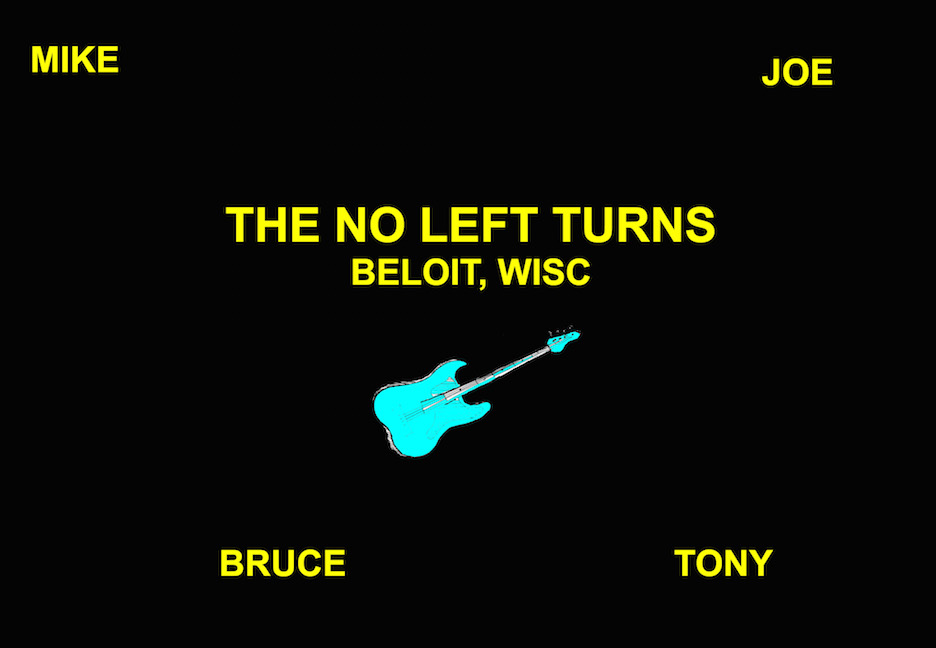
But he didn’t stop there.  To personalize it for us, Uncle Bob stenciled the band’s name on both sides, surrounded by our individual names.  He spiffed it up even more by painting a baby blue guitar under the band’s name.  We proudly hauled our gear in that trailer, pulling it behind my Dad’s Studebaker.  No photos of the trailer were ever taken and even if pictures did exist, they’ve long been lost.  That unfortunate circumstance in mind, I’m left to reconstruct a semblance of the trailer’s stenciling from memory:NLT Trailer compCarrying around our band equipment for miles on weekends, that trailer allowed all of us to travel in one car, with me at the wheel.  It wasn’t unusual to see it parked at the Hollywood Drive-In late at night after returning from a gig.  There we’d order fish and chips dinners and pay with cash from the night’s receipts.  The car would get a little crowded after Jim joined the band, but there was plenty of room in the trailer for his Farfisa organ.  Uncle Bob made him feel welcomed by stenciling his name between mine and Mike’s.

On the first day of summer recess, Mike, Tony and I drove the empty trailer away to check the tire pressure and add some air.  On the way back to my house we heard a strange rattling sound.  Pulling over to investigate, we found a few loosened bolts that secured the box to its frame.  Not having a wrench on us and fearing the trailer would shake apart, we unhitched it.  Tony and Mike would stay behind while I’d go home to retrieve a couple of wrenches.  It remains unclear exactly who did the unhitching, but driving off, I heard both Mike and Tony yelling “Stop! Stop!” while I watched them frantically waving their arms in the rear view mirror.  I braked, but it was too late.  Someone had forgotten to disconnect the electrical harness to the trailer’s rear lights.  About twenty feet of wire now lay on the pavement between the car’s hitch and the trailer’s tongue.  The ensuing argument lasted only seconds as Tony picked up the wires.  Radio volume turned up to drown out further rattling, we returned the trailer to Mike’s house where, sometime after Tony and I escaped, Mike was left to explain the day’s events to his dad.

The trailer was back in service by our next gig and we never spoke another word about the incident.  The No Left Turns even gave up trying to learn the song, Stop! In the Name of Love, three of us cracking up at every attempt, leaving Jim and Bruce to wonder just what was so damned funny.