The Fourth of July

It’s the middle of January and it’s miserably cold.  The dog shakes himself head-to-tail, then runs under the table when I approach with his leash.  Finally, I coax him into going outside with me because I know, and he knows, there is some business to which he must attend before calling it a night.  It’s miserably cold.

Business accomplished and back inside, I’m in full “inspiration mode,” trying desperately to come up with something, anything, to write about.  I scroll through pages of half-written paragraphs comprising stories I’ve started, but abandoned for lack of anything resembling a point, a direction, a potential audience.  All I can think about is summer and warmer weather.  Lounging in the sun, cool drink in hand, warm breeze lifting the sweet sound of guitars and drums through the humid air…

It’s July 4, 2015 and I’d been invited to a backyard party in a neighboring community.  “Bring your guitar,” said Kris.  “The stage will be set up with even more gear than we had last year.”  I arrived as a couple of millennials holding acoustic guitar and electric bass were attacking the microphones. They sang of joy and anger, love awakened and love lost.  Only some songs I recognized. One, an Elvis Costello tune.  “What am I doing here?” I thought to myself.  “I can’t contribute that brand of new wave angst.”

The duo left the stage and were replaced by some guys closer to my age.  Kris asked me to join them so I uncased my guitar and set about plugging in, placing my binder of songs on an unused music stand.  Making our introductions, we tuned our instruments and decided to warm up with a little rock and roll.  These guys all knew each other and played together often as a garage band.  I felt like an interloper until they asked if I could sing a Tom Petty song from their repertoire, Running Down a Dream.  One of them handed me the lyrics.  “Let’s rock,” I said.  And with that, we kicked off a forty-five minute set.

The four of us, lead guitar, bass guitar, drums, and me on vocals, did two more numbers from their song list, Spirit’s I Got a Line On You and ZZ Top’s Sharp Dressed Man.  I would have been lost without their lyric sheets.  One of them pointed to my guitar, which I’d surreptitiously placed on its stand just before we started.  He suggested I pick it up and we play some selections together from my binder.  Paging through it, he was happy to see chord symbols accompanying the lyrics.  By the time I’d strapped on my guitar, the guys had already selected some tunes, beginning with the Beatles’ Eight Days a Week.  This was followed by Roy Orbison’s Oh Pretty Woman, and Jethro Tull’s Locomotive Breath.  We were warmed up now.

A pair of challenging tunes by Pink Floyd, Brain Damage and Eclipse, and I thought we were finished.  It was then our host, Kris, joined us on electric piano.  “Let’s do Moondance,” he shouted.  Kris and I had played Van Morrison’s Moondance together on a couple of previous occasions and it was one of our favorites.  The band jammed on it for about ten minutes, with piano and guitar trading riffs between verses.  Finally, we closed the set with Tommy Tutone’s 867-5309/Jenny.  What a way to celebrate a Fourth of July afternoon!

It’s the middle of January and it’s miserably cold.  But I can almost feel that warm breeze lifting the sweet sound of guitars and drums through the humid air…
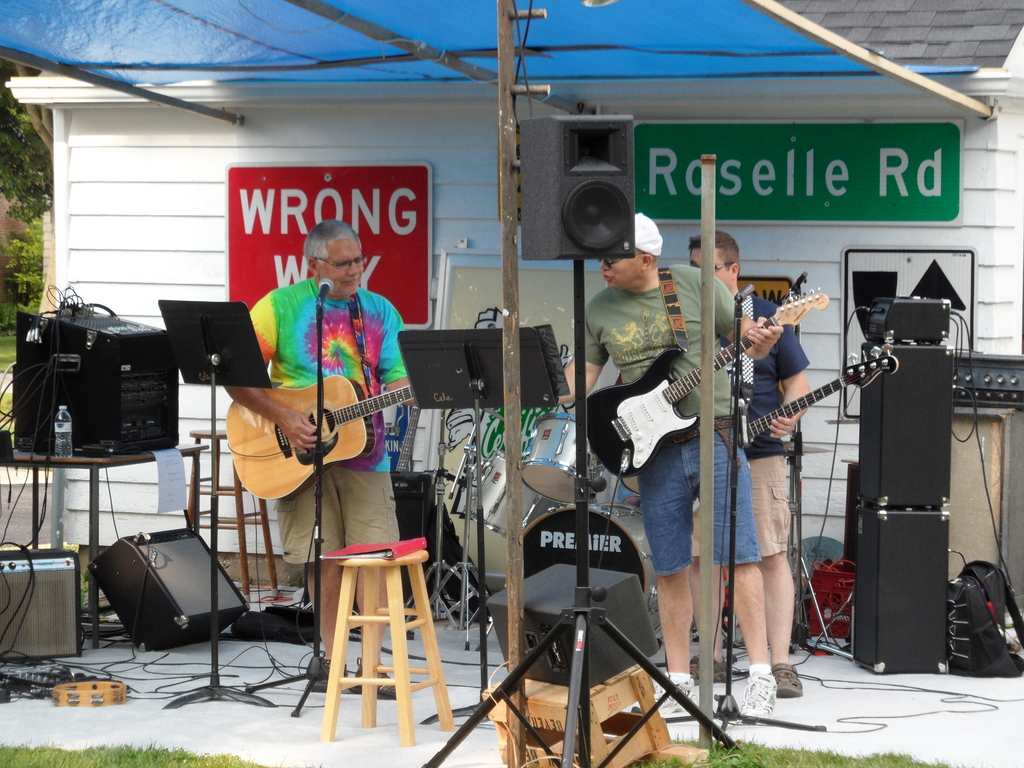
150704 Da Band
Hopefully, the sign behind me was not indicative of our performance.


Light My Fire

The phonograph needle glided into the last track on side one.  Up until that point, I was more engrossed in writing an essay for American History class than listening to the music, as good as it was.  The sudden snap of a snare drum, like the sharp report of a starter pistol, and my head jerked up toward the record player.  A flurry of organ notes, the product of assuredly nimble fingers on the keyboard, tumbled over each other, filling every shadowy space in my softly lit bedroom.  A brief vamp, and a baritone voice crooned, “You know that it would be untrue; you know that I would be a liar…”   Fully distracted from any meaningful progress on homework, I hung on every lyric, trying to wrap my head around musical patterns and song structure until my entire psyche was ablaze.

“We’ve got to get an organist,” I solemnly spoke aloud to myself.  “No way Tony can do that on a guitar.”

The song trailed off as I walked down the hallway to my parents bedroom, where the only semi-private telephone in the house was located.  I stretched the wall cord out into the hall as far as it would go and sat down on the floor to dial up Tony.

“Whaddya think about getting an organ player for the band?” I proposed.

Tony chuckled in that familiar way that typically preceded a crude comeback.  But instead he replied, “Yeah.  That would definitely help us.  We could learn some different stuff.”

“There’s a guy I know whose kid brother is supposed to be pretty good,” I said.  “Never been in a band before.”

At our next rehearsal, Tony and I decided, with Mike and Bruce in full agreement, to find an organist.  The No Left Turns had recently won the Beloit Jaycees “Battle of the Bands” and would have no problem recruiting more talent.

Jim was only a high school freshman.  The rest of us were seasoned sophomores and juniors, so we weren’t quite sure how the age gap would work out.  Nonetheless, we invited him to audition with us on Saturday afternoon.  I had to drive over to his house, just outside of town, to pick him up along with his Farfisa organ.  Jim carried it out and put it in the back of my dad’s Studebaker.

“Do you have an amp?” I asked, trying to hide my initial disappointment as he climbed into the passenger seat.

“Well, not yet, but my dad said I could get one if I got into a band,” he explained. “Can I plug into one of yours today?”

I could hardly say no, considering he’d already shut the door behind him.  All the way to my house we listened to the radio, talking with excitement about songs we liked and knew how to play — or wished we could play.  When he said he’d figured out the organ part to Light My Fire, I nearly drove up over an embankment, responding “Really?”

Arriving at my house, we unloaded the Farfisa, set it up in the basement with the rest of our gear, made our introductions and jumped right into the audition.  True to his word, once Jim had set up his Farfisa and plugged into Mike’s amp, he warmed up by playing the opening riff to Light My Fire. Mouths agape, we positioned ourselves with our instruments and worked on learning the song as Jim broke it down for us.

The sudden snap of Bruce’s snare drum, like the sharp report of a starter pistol, and our heads turned to Jim who deftly  played a flurry of organ notes, fingers tumbling over each other, reverberating off the basement walls. A brief vamp, and I crooned into the microphone, “You know that it would be untrue; you know that I would be a liar…”

nlt2
No Left Turns: Bruce, Joe, Jim, Tony and Mike (Spring 1967)

A New Lead Guitarist

Another flashback of my garage band, the No Left Turns…

“I can’t be in the band any more.”

Carl dropped this bombshell on me during a telephone conversation one cold November evening.  For a split second my “What, are you crazy?” alarm was triggered.  However, I maintained composure and calmly asked him why.  The details of his response remain as hazy as the cold night mist I noticed staring out the kitchen window.  It was transforming before my eyes into a flurry of snowflakes shimmering in the moonbeams, and grew heavier as I watched.  “Great,” I thought.  “Now I’ll be shoveling snow in the morning.”  I was good neither at enjoying lovely winter imagery, nor at listening to Carl.  Instead, I obsessed about the overnight weather outlook.  Oh.  And what in hell the No Left Turns will do without a lead guitarist who can sing harmony!  Guess it was time to hit the snow covered pavement and find a replacement.

Tony attended the public high school across the river.  Bruce and I were listening to his band at our favorite hangout, the Pop House.  Tony was their bass guitarist, but apparently he had other ambitions.  In a conversation after the gig, he agreed to help us audition guitar players for the No Left Turns.  Tony was acquainted with Bruce, our drummer, who was a grade behind him at the same school.  Word fomented in the undercurrent of high school gossip, among the swelling ranks of aspiring rock ‘n’ roll stars wandering locker-lined hallways:  “Wanted.  Lead guitarist for band.”

Someone contacted Bruce and we set up an audition with a guy for Saturday afternoon in my basement.  Our first candidate, Randy brought his electric guitar and amplifier that we helped unload from a big-finned Cadillac sporting a friendly adult behind the wheel, presumably his dad.  He set up his gear in the basement.  The guitar was a white, hollow-body style widely used by country and western players.  That should have been our first clue.  Getting down to business, we asked him to play something.  Randy picked out a few twangy notes that could have been a song, but it didn’t sound familiar.  He continued to noodle around on the fretboard until we stopped him.  “How ’bout we play something together,” I suggested.

The difference between three-chord rock and roll and three-chord country music is measured in degrees of twangyness.  Every song we tried with this guy contained flaming twang, an astoundingly bad noise when you’re playing Louie, Louie and he’s doing Ernest Tubb.  He couldn’t sing either, let alone harmonize.  Deeply disappointed, we mustered up an apologetic “Thanks, but no thanks.”  He was sent packing back up the stairs, and into his chauffeured Caddy, doubtlessly headed back toward Nashville.

“Well…” I started.
“I didn’t like him,” Mike interrupted.
“Neither did I,” Bruce added.
“Did you see his cowboy boots?” Tony smirked.  “Pointy toes.”
The tension broke and we shared a chuckle.
“Now what?” I continued.
An awkward silence filled the basement until Tony spoke.  “I’ll tell you what,” he said.  “I don’t like the band I’m in now and really wanna switch from bass to lead guitar.”
Our faces screwed up and while we began to ponder this statement, Tony picked up Mike’s Squire and ripped off a few cool riffs.
“Do you have a six-string?” I asked.
“Not yet.  But I’ve got my eye on a used Telecaster and a Fender Deluxe Reverb amp.”
An audible sigh of relief and we enthusiastically agreed to let Tony join.  He traded in his bass and amp for the new gear after school one day and was ready to rehearse the following Saturday.

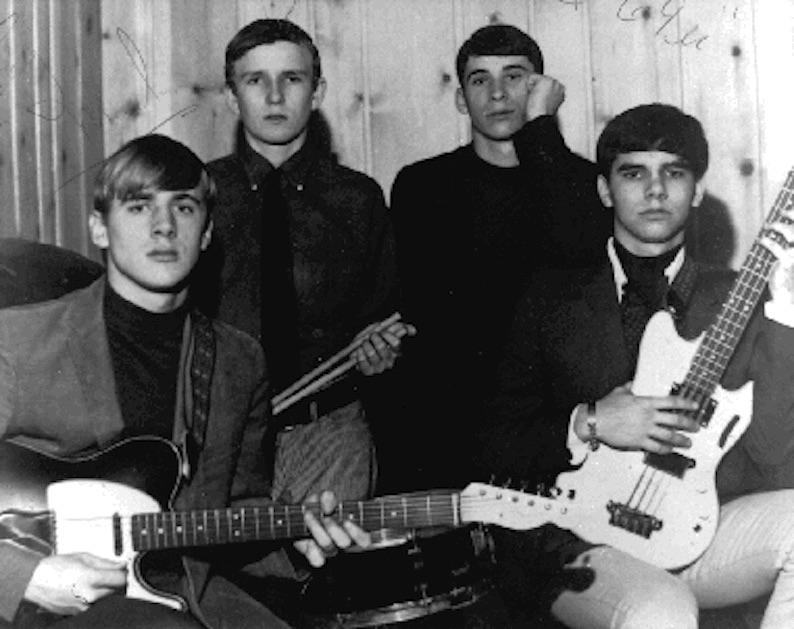
The four of us — Mike, Bruce, Tony and I — learned more new songs that Saturday afternoon than any of us thought possible.  Beatles, Monkees, Paul Revere and the Raiders, Rolling Stones.  Nothing seemed out of reach.  We were ready to round the first corner.  In one flash of brilliance we pledged never to make another left turn, walking or driving, but dismissed it in almost the same instant.  Really.  We weren’t stupid.  There was music to be played and cash to be made.  And Beatle boots to buy.

To be continued…

nlt3
The No Left Turns: Tony, Bruce, Mike and Joe


Best Singer in the Business…

I shook the hand of “the best singer in the business.”

That’s a bold claim that was brought to mind while watching the Frank Sinatra 100th Birthday Tribute televised last night.  No, I never shook Sinatra’s hand.  Nonetheless, it was something he said in the 1960s that supports my claim today.  Back then, I’d hear an occasional Sinatra song on the radio or see him perform on a late night variety show.  Was he egotistical enough to claim the title “best singer in the business” for himself?  He certainly had the swagger, the impeccably tailored suits and, most importantly, the talent that had earned him nicknames like “The Voice,” “Chairman of the Board” and “Ol’ Blue Eyes.”  But he wasn’t referring to himself, even though he perhaps really was the best.  He was talking about Tony Bennett.  Sinatra had once said of Bennett, “For my money, Tony Bennett is the best singer in the business.”

Sylvia and I saw Tony Bennett perform with Diana Krall at Ravinia on their “Two for the Road” tour during the summer of 2000.  By that time, having known his real name was Anthony Dominick Benedetto, we’d begun referring to him as “Uncle Tony.”  Before the Ravinia concert I’d only seen him perform on television, including an appearance on MTV Unplugged in 1994.  For my birthday later that year, I scored a CD soundtrack recording of the MTV show.  It won a Grammy the following year in 1995.

When his autobiography, The Good Life, was published in 1998, I wanted an autographed first edition.  Luckily for me, Uncle Tony was appearing at a Barnes & Noble bookstore signing event nearby.  The line waiting to buy his book from one of several tables stacked high didn’t appear nearly as long as the line that coiled around the store aisles, fans like me pursuing an autograph.  A sales clerk handed me a book as I completed signing the credit card receipt.  Then I joined the slow-moving snake of shuffling feet winding their way around bookshelves to a low platform where Tony Bennett was signing autographs, flanked by men in dark glasses looking like Secret Service agents.

He appeared almost trance-like until, catching him off guard, I greeted him in Italian, “Zi’ntonio!  Come stai?”  His eyes blinked a couple of times, then he smiled broadly and responded, “Sta bene!”   He signed my book as well as the MTV Unplugged CD I’d brought along.  Looking me in the eye he said, “That Unplugged CD is my favorite recording.”  I replied that it was my favorite too as he grasped my extended hand.

So, I’d have to agree.  Uncle Tony is the best singer in the business.  Just ask the Chairman of the Board.

UncleTony

Grateful for Thanksgiving

Every Thanksgiving we gather together, family and friends, to enjoy each other’s company, give thanks and share a traditional meal of roasted turkey with all the trimmings, maybe a green bean casserole, pumpkin pie and the Grateful Dead.  Er, what?

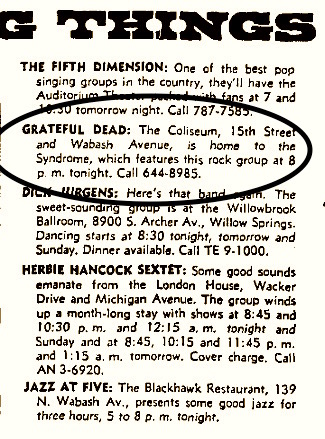
Home from college for the 1970 Thanksgiving break, a friend (and former band mate) and I were discussing the benefits of various aids to digesting the previous day’s meal.  Pondering our options, we concluded that drinking beer would be good, but a Grateful Dead concert would be a more entertaining alternative.  More adventurous too, as the Dead were scheduled that night in the old Chicago Coliseum, renamed the Syndrome and now home to weekly rock concerts.

701127 ChiTrib GratefulDead
November 27, 1970 Chicago Tribune

We took off in Mike’s VW Beetle, heading from Beloit to Chicago on the Northwest Tollway, then wound our way around some dark city streets to the decrepit, aging venue where our senses would soon be flooded by a barrage of music and lights.  Upon locating some questionable street parking, we locked the VW and meandered to the box office, paid our admission and filed into the building, grabbing seats on the dirt floor with the other Deadheads.  A few devoted fans, or perhaps they were members of the band’s road crew,  stepped lightly through rows of crossed legs and tie-dyed shirts, distributing “party favors” among the enthusiastic audience.

At concert time, the house lights dimmed and an opening band, the New Riders of the Purple Sage, kicked it off with a country-folk sound that included pedal steel guitar, masterfully played by Jerry Garcia of the Dead.  It was a mellow, easy-going noise that morphed into electric music with more Grateful Dead band members joining in.  Their finale, and highlight of the NRPS set, was a country-laced cover of Honky Tonk Woman that had everyone up and dancing.

The metamorphosis completed itself with remaining Dead members plodding out to the stage, taking up their instruments and blasting out the opening chords to Casey Jones.  For the next few hours, we were blown away with music ranging from deep rhythm and blues to soaring psychedelia.  When the final strains of Turn On Your Lovelight reverberated through the hall, a thousand or more fans were on their feet, dancing and spinning to the music and lights.  It was a psychedelic experience to be sure.

When the concert ended, I volunteered to drive home.  That return journey would have been routine save for the VW’s brake pedal unexpectedly failing as the car hurtled toward a toll booth.  Mike, sleeping soundly in the back seat, was of little help.  Coasting through an open toll gate, it dawned on me to pull up on the hand brake.  The Beetle came to rest about a hundred feet beyond the toll plaza.  Reaching into my pocket, I counted out thirty-five cents in change, stumbled out of the car and trotted back to the booth.  I handed the change to a puzzled toll collector, mumbled an apology for the brake failure and scooted back to the car.  Hand brake and I became close friends the rest of the way home.

Every Friday after Thanksgiving, I commemorate that Grateful Dead concert by queuing up the album Live Dead, relaxing in my recliner with a set of headphones over my ears, and taking solace in the knowledge, grateful you might say, that I won’t be braking for toll booths after the record ends.

He Was a Friend of Mine…

Our eighth grade basketball team was looking forward to its game that night.  The entire school had gathered in the building’s main hallway during the noon hour, cheerleaders in their blue and white plaid skirts leading shouts of “Go Team, Go!”  It must have been difficult for our principal to raise his voice above all the noise.  When he finally got our attention he announced, voice faltering, that President Kennedy had been shot in Dallas.  Gasping and then silence among us.  Stunned, I walked back to our classroom.  We listened to the news broadcast over the school’s PA system.  President Kennedy was dead.

Two years later I bought an album by the Byrds, Turn, Turn Turn!, on which they included a traditional folk song, lyrics altered to lament the assassination of President Kennedy, He Was a Friend of Mine.  Every year on this day I am reminded of that song and the depth of my sadness surrounding the event 52 years ago.  Where were you that day?

Byrds

Stranger in Paradise

Sifting through a worn shoe box of old family photos many years ago, I spotted a black and white snapshot of five-year-old me playing with a toy drum kit in front of the Christmas tree.  Placing it back in the box, I forgot about that old picture until recently when my sister located it following a brief volley of emails between us.  She scanned and sent it to me, confirming my memory.  Drumsticks in hand, my arms are poised to pound on those skins like a ham-fisted carpenter ready to drive nails into a two-by-four.  Not an unwelcome surprise, my sister was in the photo too, sitting in her tiny rocking chair, cradling a life-size baby doll in her arms.  Why didn’t I remember that?   Rather than obsess, I cropped her out of the shot to more closely match my memory of the event.  Don’t worry.  She still has the original print.  I don’t know what ever became of the drums or the rocking chair, but my sister is fine and I never grew up to be the next Gene Krupa.

Joe - Christmas 1955
Author with drums. No sister.

As a kid born of first generation American-Italians, it was only a matter of time before picking up a real musical instrument would become reality.  A search for just the right one began in grade school.  It might have been a  Harold Hill-type salesman from the local music store, dropping high-pressure buzzwords like “woodwind” and “embouchure” and “Stan Getz.”  Or perhaps it was the sweeping shape of the instrument itself, brass keys gleaming in the sunlit storefront window, beckoning like a siren singing to Odysseus.  Whatever the circumstances, a slightly tarnished, used alto saxophone was selected and brought home.  A small tag which carried a handwritten rental number was secured by white string to the handle of its carrying case.

Accompanying the instrument were private lessons at the music store and group lessons at my grade school.  Group lessons evolved into the formation of a small combo which, for all intents and purposes, was called a band.  It was comprised of one or two clarinets, a cornet, a flute and my saxophone.  The instrument also was accompanied by the requirement of regular practice to make its rental worth the monthly cost.  Apparently, I did well enough over time to earn a saxophone of my own, compliments of Mom and Dad.  To show my appreciation I practiced faithfully and learned a handful of songs.

Know it or not, you’re probably familiar with Alexander Borodin’s musical composition, Gliding Dance of the Maidens.  Specifically, it’s the second piece from a long set of eight Polovtsian Dances in Borodin’s even longer but never finished opera, Prince Igor.  Few people recognize it by any of those names.  The sheet music I rehearsed was indeed titled Gliding Dance of the Maidens.  But underneath that bold print, a small parenthesized subtitle indicated it not only was the Theme from Prince Igor, but a popular song, Stranger in Paradise, from the 1953 Broadway musical, Kismet.  Like much of the music in Kismet, its melody was borrowed from Borodin.

The first band recital for our classmates was presented via the magic of technology.  Our ensemble was huddled in the rear part of an all-purpose room, surrounded by painted concrete block walls.  It’s my educated guess the nuns weren’t thrilled about herding three hundred or so crumb grabbers through the hallway and into such a cramped space, so a microphone connected to the school’s PA system stood in front of us.  At the appointed time we played America the Beautiful, perhaps a Sousa march, and then a couple of solo pieces.  Emanating from wall-mounted classroom speakers, my Borodin/Kismet solo caused at least one girl from my eighth grade class to swoon.  That was the rumor, verified the following day by the girl herself, blushing cheeks and all.

In theater, a wonderful dress rehearsal can sometimes lead to a disastrous opening night.  The same might be true for eighth grade recitals. That in-house broadcast led to a citywide, evening recital in the Lincoln Junior High School auditorium.  In attendance were my family, my aunt and several hundred strangers.  Though I’d rehearsed a couple of times with piano accompaniment from my teacher, the accompanist tonight would be someone whom I’d never met.  Her rhythm and timing  resulted in us both rushing through Borodin’s composition at a tempo more suited for circus calliope than for alto sax.   Worse, a new mouthpiece reed stiffening against my tongue made some previously sweet notes sound like a goose honking overhead.  Polite applause greeted the song’s coda.  Now the only blushing cheeks were mine.

With summer approaching, beyond which freshman year of high school awaited, I quietly gave up practicing the alto sax.  Turning my musical attention to a recently gifted electric guitar, I chose the Beatles over Borodin.  The saxophone and I soon became strangers and the paradise of rock ‘n’ roll glowed brightly on the horizon, inviting me to enter its glittering gates.

Making a (No) Left Turn

The deal to work as a private groundskeeper that summer was struck between Dad and one of his well-to-do customers.  Starting on the first sunny day of summer vacation, I quickly learned to appreciate working outside for the prevailing minimum wage, a buck twenty-five an hour.

That summer job enabled me to buy a new bass guitar.  The band needed a bassist and I thought four strings were way cooler than six anyway.  It was a Kalamazoo KB, manufactured by the respected Gibson guitar company but it sported a Fender Mustang body style.  Years later it was rumored the material comprising its body was manufactured from the same wood product used in making toilet seats.  The joke was that it sounded like crap.  In spite of that, it was Gibson’s best-selling bass guitar at the time and it sounded pretty good to me.

I really had two jobs that summer.  The other one was auditioning drummers.  It was light work compared to mowing and reseeding lawns.  Bruce was the first guy who lugged a complete drum set down the basement steps, assembled it, and immediately demonstrated the solo to Wipe Out.  The rest of us joined in, adding yet another three-chord opus to our growing repertoire.  The adolescent bathroom humor would eventually find its way into our public performances as we’d introduce the number as “our favorite toilet paper song.”

Whether it was the audition itself or the fact that Bruce owned a complete drum kit with cymbals, kick bass, and high hat that tipped the scale in his favor, I’m not sure.  Regardless, we now had a real drummer and could learn more songs.  We wasted no time practicing at decibel levels approaching the stratosphere.  To this day, my mother claims to have enjoyed every minute of it.  Mom is a saint.

“If you don’t mind, I’ll just leave my drums here,” Bruce said when we’d finished the audition and it was time for everyone to go home.  “I have practice pads at home.” That inspired my cousin to leave his amp and so my parents’ basement was instantly transformed into our permanent rehearsal hall.  After a couple more practice sessions, Bruce phoned me one evening to suggest getting business cards printed up.  “My brother is a photographer,” he explained.  “We could pose for some pictures and use them for publicity with the cards. By the way, what’s the name of our band?”
When I responded “O-Geez,” I thought he’d never stop laughing.
“OK, we need a new name,” I confessed.  “Let’s think about it.”

Saturday rolled around and I met Carl at a local coffee shop.  Sitting across from each other in a booth next to the front window, I ordered a Coke and Carl ordered coffee.  “We need a new name for the band,” I said.  He looked at me, looked down at the menu, and then stared out the window for a minute before he spoke.
“How about the No Left Turns?” he asked, still staring out the window.
“Huh?”
“No Left Turns”
“For the band?”
“Yeah”
I thought a while, stirring the ice in my Coke with a straw. “Where did that come from?”
“Take a look outside,” he said, nodding his head in the direction of the window.
I craned my neck to look through the glass over my shoulder.  There it was.  Posted under the red stop sign at the parking lot exit was another sign that read “No Left Turn.”
“Cool. I like it!”  From that point on, our band would be the No Left Turns.

We continued to practice in the basement.  One day Bruce hitched a ride over with his older brother, Gordy, an amateur photographer with a 35mm SLR camera and darkroom.  “Gordy thinks we should have some publicity pictures to go along with our new business cards,” Bruce exclaimed, bounding down the stairs.  Then he pulled out a box with freshly printed business cards.  Centered on each was “Music by the No Left Turns” and the tagline “(We Gotta Be Right).” At the bottom was Bruce’s home phone number.  Our names were printed individually in each corner of the card.  It was a masterpiece.

nltcard

The day was overcast and Gordy thought it would be perfect for taking some pictures.  The five of us piled into his Chevrolet Bel Air and headed downtown.  “I already scoped out the perfect location,” he announced as we parked just around the corner from the Beloit State Bank.  We climbed out and ambled over to a spot where the bank’s drive-through exited to Grand Avenue.  And there it was.  The most beautiful “No Left Turn” sign we’d ever seen, mounted under a stop sign on a post behind a flowering shrub.  Across the street, the Corinthian columns of the post office formed a perfect backdrop.  Gordy shot an entire roll of black and white film as we posed in various ways.  A week later we saw the 8×10 prints and understood.  The No Left Turns were driving straight up the road to stardom.  No turning back… or left.

65_NLT_Carl
The No Left Turns: Bruce, Joe, Mike, Carl


Excuse Me, I Got Carried Away

I’d just completed my freshman year in college and was home for the summer.  Dad lined up a job for me through one of his buddies in the personnel department of Fairbanks-Morse where I’d be working in a factory that manufactured diesel engines for ships and trains.  Perhaps he thought working in a sweaty, loud environment would encourage me to stay in school.  I guess he hadn’t visited my dorm recently.

When the whistle blew at 3:00 pm, ending my shift, I’d sometimes meet up with Carl and we’d hang out, listen to music, practice our guitars, harmonize and wax philosophical.  Carl and I hadn’t played music together for a couple years following his departure from the now long-defunct No Left Turns.  But this summer we entertained ourselves and a few close friends by plunking out some tunes we learned.  It was mostly stuff by the Beatles, Dylan, Donovan, Judy Collins and a few others. We worked out a pretty good arrangement for the song Two Of Us  by the Beatles.  At least one of us was a folksinger wannabe.  You can probably guess who.

While I was busy in the sweatshop, Carl was enrolled in a summer theater workshop at the University of Wisconsin Center-Rock County, sponsored by their drama department.  690611 JanesGaz Workshop 1Often, I’d accompany him to workshop sessions where our creative juices mingled with those of like-minded music and theater junkies.   That talented group would work on play writing and hash out ideas for producing and staging a show.  A public performance was planned for the finale, designed as a coffeehouse program to include original sketches, interpretive dance and folk music.  I was drafted, without resistance, to be the evening’s folksinger, having honed my chops the previous fall in a basement coffeehouse at Saint Mary’s College across the road from Notre Dame where I’d be headed back to school and my girlfriend in a couple weeks.

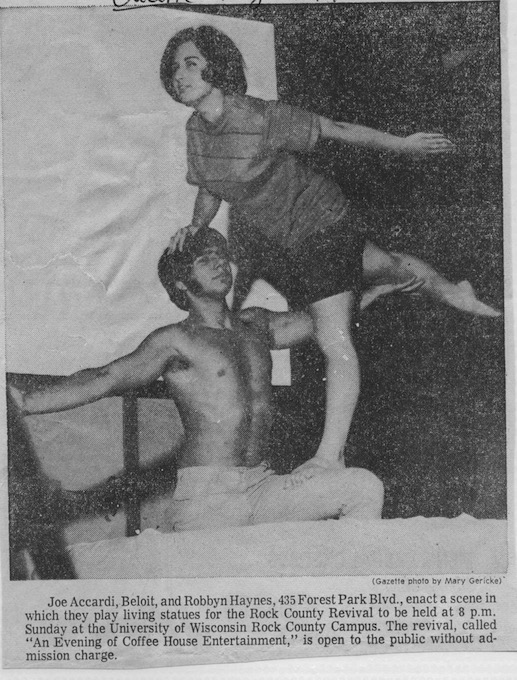
“Rock River Revival: An Evening of Coffee House Entertainment” was presented on a balmy Sunday night in the all-purpose room at UW-Rock County.  Acting and dancing our way through the evening, I hammed it up in the role of “Ferd Barks, Master of Ceremonies” for an original satire, Miss America – A Great Tradition690800 Gazette Dancers Additionally, an interpretive dance was choreographed to lampoon the old Carrie Jacobs Bond parlor song, A Perfect Day.  Bond was a Janesville, Wisconsin native perhaps most noted for her song, I Love You Truly.  The dance sequence involved “living statues,” one of whom was me.  It was my first arabesque.

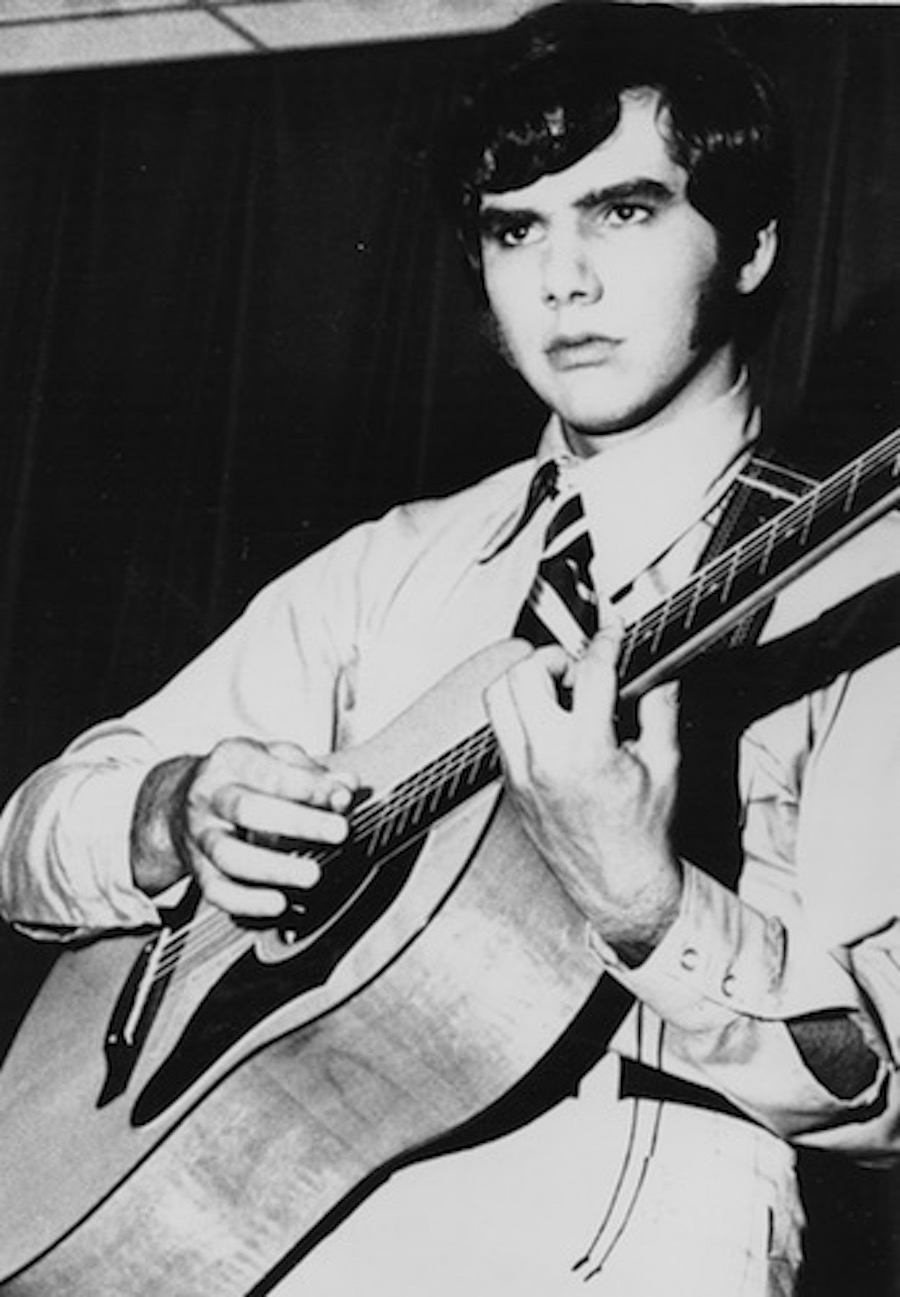
The final slot of the evening was the much anticipated (by me, anyway) folk singing during which I stood solo 690816 BDN txtwith my guitar on the proscenium stage in front of a drawn velvet curtain, nearly blinded in the bright spotlight.  It was my Bob Dylan moment to be sure.  I even recall playing a couple of Dylan songs, You Ain’t Goin’ Nowhere and It’s All Over Now, Baby Blue,” in addition to several by other popular folksingers of the day.

The problem with standing in a spotlight is that it’s sometimes difficult to judge the passing of time or gauge audience yawn-frequency.Folksinger Joe  You’re sort of drifting in space, especially when you don’t have a written set list and you become oblivious to how far beyond the allotted fifteen minutes you’ve gone just singing whatever songs pop into your head.  It must have been disappointing for the stage manager to be without a shepherd’s hook at that precise moment. So he did the next best thing.  He sent Carl out to physically lift me up and carry me offstage, much to the delight of the exhausted audience.  I never really figured out whether they were applauding my performance or Carl’s.  Either way, I remain fairly certain they thought it was part of the show.


The Sicilian Wedding Singer

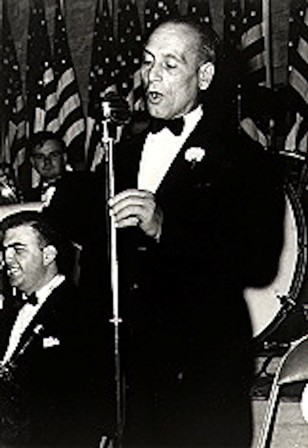
My Grandfather was a wedding singer.  No, not a wedding singer like Adam Sandler in that movie of the same name.  Grandpa would sing purely for the love of it.  I doubt that he was ever paid to perform.  Giuseppe Accardi grandpaAmericanized his name to “Joe” after he landed a foundry job upon immigrating from Marsala, Sicily to Beloit, Wisconsin in 1921. Unfortunately, he died in 1956 when I was only five years old.  I don’t recall ever hearing Grandpa sing publicly.

If you’ve attended a traditional Sicilian wedding reception, you know it’s an extraordinarily joyous celebration involving ritual, food, wine, music and dancing. The food is homemade.  The “sweet table” is nothing short of phenomenal.  Sometimes the wine is homemade too.  The dancing is contagious.  Most importantly, the music is performed live by a band whose instruments might include an accordion, a clarinet, a guitar and a drummer.  I recall a clarinetist who appeared to have one glass eye that never moved with his other one. I recognized him at a number of wedding receptions when I was a kid.

The musicians typically were themselves Italians and played tunes ranging from traditional tarantellas, to swing, to songs that might have been featured on Your Hit Parade, a popular radio show back then.  One or more band members also would sing.  They sometimes invited guests to participate.  That was the proverbial “drop of a hat” resulting in Grandpa joining the band.  Apparently, Grandpa Accardi, with his resonating baritone voice, gained quite a reputation among friends and family at these gatherings.  Eventually his role in weddings was cast ahead of time, judging by this clipping from page 3 of the June 9, 1935 Rockford Morning Star:

Fast forward fifty years. The Janesville Public Library board president heard a radio broadcast in the fall of 1985.  Sima arrived unannounced at the library director’s office door to question me about it.  Surprised, I stood to greet her.  “Joe, did you ever make a record of Italian songs?” she asked without warning.  Thinking on my feet, I deftly answered, “Huh?”  She ignored my response and described listening to Joe Accardi of Beloit, Wisconsin singing “delightful” Italian songs on a Wisconsin Public Radio program called Simply Folk.  Understandably baffled, I phoned the Madison station after our brief exchange and spoke with producer Judy Woodward.  She read a description to me that accompanied the recording.  Well, that could only have been my grandfather!

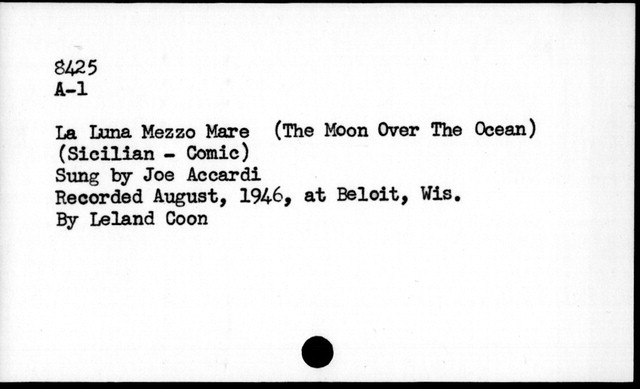
The song, Luna Mezzo Mare, was selected from a collection of forty-year-old 78rpm shellac discs housed at the University of Wisconsin Mills Music Library in Madison.  Further conversation with Judy, and later with my Dad, revealed that on a warm summer’s day in 1946 Grandpa was invited to record seven Italian songs for the Wisconsin Folk Music Project, a federally-funded program initiated in 1939 to preserve America’s ethnic folk music.  Excited to learn I was the grandson of singer Joe Accardi, Judy mailed me a cassette copy of all seven songs.  Eventually acquiring technology to transfer the songs from cassette to CD, I duplicated and shared them with other family members.

The original 78rpm recordings remain housed both in Washington, DC and in Madison.  In 1998, Sylvia and I traveled to DC for the American Library Association Conference where we took advantage of some free time to visit the Library of Congress.  There we heard all seven songs while seated at a private listening station.  grandapa LC catalog cardContents of the shellac discs had been transferred to a seven-inch tape reel which was carefully mounted on a deck for playback through headphones.  The catalog card reproduction shown above is still filed with several others bearing Grandpa Accardi’s name and song information in the Library of Congress.

locbSometimes when I close my eyes and listen to his recording, I imagine grandpa at a microphone on the bandstand, musicians playing on their instruments behind him, and the dance floor animated with guests twirling in their colorful wedding attire.  As for me,  I’m sneaking over toward the sweet table to grab a cannoli, humming along with Grandpa while he sings Luna Mezzo Mare.  (If you click on the song title, you can hum along too!)