Jonathan Edwards

Note:  I’ve been a fan of Jonathan Edwards (the singer/songwriter, not the 18th century theologian) since first hearing his music in 1971.  It took all these years until last night before I heard him perform in concert.  It brought back memories of my first encounter with his music.

Having returned home from college for the weekend, I wasn’t around that October night Poco performed at Notre Dame.  I heard it was a great concert with Poco delivering on their promise at the outset about getting the crowd to “kick up their heels and never let up.”  They had the audience dancing in the aisles.  What I really missed that night, though, was the party after the show.

Frank, my apartment mate, and I hung out with some classmates who lived in a large house they rented outside of town in the middle of a corn field.  The seclusion of this place, notoriously referred to as “the Ranch,” made it an ideal location for parties.  Loud parties.  The living room furniture consisted of two old, comfortable sofas, an equally comfortable easy chair and a high-end stereo system whose gigantic twin speakers were once used in a P.A. system for a rock band one guy had been in.  As I said, the parties were loud.
Enjoying the after-show party I missed that night at the Ranch were not only the usual suspects, but members of Poco who were invited by “someone who knew someone.”  While my friends were rubbing shoulders with the likes of Richie Furay and Timothy B. Schmit (years before he joined the Eagles), I was rubbing noses with my hometown honey. I look back now and wonder, “What the hell was I thinking?”

The following weekend featured another party at the Ranch, a welcome respite from hitting the books all week long.  Still flying high, so-to-speak, from the week before, a lively discussion ensued about Poco’s show and subsequent appearance at the party.  Ed, the party’s host, picked up a record album.  As he slid the vinyl out of its sleeve and placed it on the turntable, Ed recounted a discussion he’d had with some Poco guys.  He’d asked them what music they listened to when they weren’t playing their own.  They said at the moment they were listening to a new singer/songwriter by the name of Jonathan Edwards.


Ed cranked up the volume as the first track began to play.  Everybody knows her.  She’s the one to love… came blasting out of those speakers.  “This is the guy they were talking about,” Ed announced when the song finished.  We listened to the next five songs on the album’s first side in virtual silence.  Wow!  Great stuff!

Browsing the record bins in the campus bookstore a few days later, I ran across that eponoumously titled album by Jonathan Edwards.  I snatched it up and and trotted over to the cashier, plunking down my three bucks and forgetting entirely about whatever else led me to the bookstore initially.  I couldn’t wait to get a listen back at the apartment, pull out my guitar and start learning how to play those songs.  It was a lofty challenge, but I learned to play a couple and would sometimes include them when entertaining myself or my apartment mates late at night.  One song, Shanty, remains in my repertoire to this day.

Thanks for the years of great tunes, Jonathan Edwards.  Such beautiful imagery from a guy who shares his name with an 18th century preacher man.

161104-je
Sounding great at the Altamont. November 4, 1016

Jonathan Edwards – Everybody Knows Her :

A Halloween tale: a lamp, a banshee and a nightmare

When I was a young boy, Walt Disney released a movie that made a lasting impression on me.  It turned out to be the source of a recurring nightmare for quite some time.  The film was Darby O’Gill and the Little People.  The innocuous title belied multiple appearances of a very scary creature in the film called a “banshee.”

I lived with my parents and younger sister in a small, two-bedroom home.  The living room, kitchen, bathroom and both bedrooms all opened into a small hallway.  Mounted on the wall of that hallway was a single light fixture. The lamp’s stem stuck out of its wall plate in a downward, then upward curve to an upright socket fitted with a round, squaty, frosted glass chimney shade.  When it was dark in the hallway, you’d flip the switch turning on the lamp which projected, upward and around, an eerie glow that in itself was scary enough. But it also cast a shadow on the wall behind and below which, in the active mind if an eight year old, resembled a dark, flowing cape or robe.  I used to run through the hall from one room to another, especially at night, averting my eyes from that lamp as much as possible.

Witnessing a banshee on the big screen in a darkened theater, then coming bansheehome to an already tenuous hallway situation with terrifying light and shadow, inevitably led to regular nightmares.  They were nightmares from which I’d awaken with a start, heart beating in my throat.  In each nightmare, the hallway lamp would come to life as the banshee, howling and reciting something that I’ve mostly forgotten, but which always ended with the phrase, “…all your ages and wages.”  I have no clue what it meant, but it scared the crap out me.

And that’s what I think about every Halloween.  What’s your nightmare?

Here’s a movie clip (click on it and see for yourself):  Darby O’Gill and the Banshee


City of New Orleans (or was it Chicago?)

The details are a little hazy after all these years.  I suppose that isn’t unusual considering the intertwined memories involved.  What would the Chicago Cubs and Arlo Guthrie have in common anyway?  If you’d ask Guthrie, probably not much.  But memories continue to  churn as they challenge me to line up the details just enough to connect at least some of the dots.

I last saw Arlo Guthrie on Valentine’s Day 2016, in a concert marking the 50th anniversary of his epic Alice’s Restaurant and it was a great show.  One tune he performed was City of New Orleans, a song penned by Chicago’s late Steve Goodman.  You should be well-acquainted with Steve Goodman by now, or at least one of his more widely heard songs, Go Cubs, Go.  Among all songwriters and most of the general public, Goodman was undoubtedly the world’s most devoted Chicago Cubs fan.

Introducing City of New Orleans, Guthrie told a story about the song and his first encounter with Steve Goodman in 1971 at a club in Chicago.  He didn’t mention the club’s name, but his description of the venue, his performance and the circumstances surrounding their meeting sent chills down my spine.  He talked about how tired he was at the end of his second show, when a young guy with a guitar approached and asked if Guthrie would listen to a song he’d written.  Arlo admitted he wasn’t very gracious to the stranger and tried to leave, claiming to be tired and not wanting to hear any more songs.  But the young songwriter, who introduced himself as Steve Goodman, continued to press him.  So Guthrie made him a deal.  If Goodman would buy him a beer, Guthrie would listen for as long as it took to finish the beer.

Goodman played his new composition, City of New Orleans, and asked if Guthrie wouldn’t mind passing it along to Johnny Cash.  Guthrie was so taken by the song and the young songwriter that he eventually asked permission to record it himself.  Arlo Guthrie recorded and released City of New Orleans in 1972.  It became a hit for Guthrie and paid for Goodman’s rent (and Cubs tickets) for years to come.

It was cold that January night in 1971.  A college buddy and I had driven to Chicago for a concert.  We drove to Chicago quite often for concerts and I thought this time it was to hear Small Faces featuring Rod Stewart.  Whoever it was cancelled due to illness, leaving the two of us in the Windy City with no particular place to go.  We headed to Old Town where we spotted a flyer stapled to a utility pole.  Arlo Guthrie was appearing at the Quiet Knight, a music club in Lincoln Park.  We climbed back into the car and drove over to the corner of Lincoln and Belmont avenues.

We enjoyed listening to Arlo Guthrie’s late show that night.  I recall someone in the audience shouting out a request for him to play Alice’s Restaurant.  His response was, “Go see the movie.”  I can only imagine the mood Guthrie might have been in after playing two shows, then being approached by a young stranger, guitar in hand, asking him to listen to an original song.  We can all be grateful he was thirsty enough to make that offer, though.  Sometimes a beer for a song isn’t such a bad deal after all.

710122-chitrib-edit

Bob Dylan and me

NOTE:  I began writing this story several months ago, but put it aside.  It’s published now in honor of Bob Dylan receiving the Nobel Prize for Literature.

I first heard about Bob Dylan in 1963 when a radio disc jockey played Peter, Paul and Mary’s record, Blowin’ in the Wind.  I didn’t know what a cover version was in grade school.  But I recall the DJ talking about a young protest singer named Bobby Dylan who wrote the song, a name I initially misheard as Bobby Darin.  Dylan’s name came up some time later when the station played another Peter, Paul and Mary record, Don’t Think Twice, It’s All Right.  Though I still hadn’t heard Bob Dylan, I did begin to appreciate folk music thanks to Peter, Paul and Mary.

The March on Washington was all over the news later that summer and while Martin Luther King had a dream, Bob Dylan had a song.  I finally saw him in a television news piece singing a few lines of Only a Pawn in Their Game.  It began, “A bullet from the back of a bush took Medgar Evers’ blood…”  Whoa!  Who the heck is Medgar Evers?  I knew about the the man who shot Liberty Valence, but I’d never heard of this guy Evers or the guy who shot him.  It would be a few more years before I understood the awful truth behind that song, long after Dylan penned his more topical works.

That fall I entered eighth grade and had other things on my mind like girls, cars, and anything California.  Thank you, Beach Boys.  All those things important to a young teenager came crashing down in November with the assassination of a beloved U.S. president.  The accompanying void was filled by homework and more thoughts of girls, cars and anything California.  Until February 1964 when the Beatles changed my world.  I wanted an electric guitar.  I wanted not only to listen to music, I wanted to play it.

Top forty radio — Motown, the Beatles and the rest of the British invasion bands — filled my musical world through freshman year in high school and starting a band became my new pursuit.  The summer of 1965, out of a tinny radio speaker, a new song captured my attention.  If any description of “mind blowing” could be more apt, Mr. Tambourine Man by the Byrds was a perfect fit.  The jangling electric guitar, steady beat and obscure lyrics painted enough vivid pictures in my head, to compel me to get their debut album.

I’m a reader.  So naturally I read the liner notes on the back of the album sleeve.  Bob Dylan’s name was mentioned several times as he’d written four of the album’s twelve songs, including Mr. Tambourine Man.   I liked the album, but was especially knocked out by those four Dylan songs that also included Spanish Harlem Incident, All I Really Want To Do and Chimes of Freedom.  Thus began my pursuit of more Dylan.

The first Bob Dylan album I bought was his newest release at the time, Bringing It All Back Home.  It contained eleven songs, four of them longer than five minutes, including the original Mr. Tambourine Man with more verses than I ever imagined possible.  It got even better when I finally heard Dylan on the radio that summer singing a new one, Like a Rolling Stone.  I was hooked and Dylan was my drug.

Since that time, I’ve never lost my appreciation for Dylan and his music, even though some of his albums garnered few, if any, critical accolades.  I’ve added nearly all of them to my collection, whether in vinyl, compact disc or digital download.  In browsing through my  Dylan vinyl, I even found two different copies of Great White Wonder, the first authentic bootleg album that I still believe might be worth a few bucks someday.  As for Dylan concerts, I’ve only been to three.  They were in 1978, 1986 and in 2008.  I haven’t attended another for a variety of reasons but I listen to enough music any given day to hear a bundle of Bob quite regularly.

His songs remain a part of my acoustic repertoire, a repertoire I performed in campus coffee houses long ago.  Now, I play them for my own enjoyment and to entertain a few friends on occasion.  When you read great literature, you can sometimes quote specific lines or even entire passages from memory. When it comes to Dylan, I once was able to recite all the lyrics to most of his pre-1970 catalog.  Those memories have faded a bit, but I’ll always recall these, among the first I ever learned and, in my admittedly biased view, of Nobel quality…

Yes, to dance beneath the diamond sky with one hand waving free, silhouetted by the sea, circled by the circus sands, with all memory and fate driven deep beneath the waves.  Let me forget about today until tomorrow.  Hey, Mr. Tambourine Man, play a song for me.  I’m not sleepy and there ain’t no place I’m going to.  Hey, Mr. Tambourine Man, play a song for me.  In that jingle jangle morning I’ll come following you.”

I Love Hearing Songs About (Your State’s Name Here)

An anonymous friend of ours — let’s call her, um… Lynn — sent me a recent Washington Post article titled “The states that Americans sing about most,” a subject that naturally piques my interest.

It describes the work of a data scientist who set out to answer the question of which states are more or less frequently mentioned in contemporary music.  Her results are summarized in the article and also are presented in map-like images called cartograms.  Not surprisingly, California and New York stand out as winners, with Georgia and Texas not far behind.  I shared the article with Sylvia and we discussed the results, concluding that it wasn’t especially surprising to see California in the top spot.  California is likely to retain that honor with many tribute songs in memoriam long after it falls into the ocean.

Offering no specific song titles in the article as examples, I was moved to view the study from a different angle.  I asked myself what three songs in which a state name is mentioned come to mind first.  So, I’m guilty of reducing a well-conceived and very interesting scientific study into something like a column heading on Jeopardy.

In the spirit of quasi-scientific inquiry, I asked Sylvia which songs mentioning states were the first three that popped into her head.  Sure enough, her first response was Hotel California by the Eagles, further support for having no reason to think California shouldn’t claim the top honor.

Interestingly, Sylvia named Georgia on My Mind, a Hoagy Carmichael song, as number two.  Georgia is among the top states mentioned in song.  Of course the definitive version of Georgia on My Mind performed by Ray Charles also happens to be Georgia’s actual state song, qualifying it as a sort of Daily Double.  John Denver’s Rocky Mountain High came in third with its lilting reference to Colorado.  It was surprising to learn from the study that Colorado isn’t mentioned more often.

Then it was my turn to respond and three song titles immediately came to mind.  The first one was California Girls by the Beach Boys.  Again, easy to see why California comes out on top.  Depending on your age or your taste in music, you might have named Dani California by the Red Hot Chili Peppers.  It’s a catchy tune and even mentions two or three states in addition to California!

At first glance, Montana doesn’t appear to be among the top states mentioned in song until you look more closely at the data.  For its size and population, Montana is mentioned rather frequently in song lyrics.  That in mind, the second tune popping into my head was Frank Zappa’s Montana.  I wondered if anyone else counted “Going to Montana soon, gonna be a dental floss tycoon…among their top three memorable song lyrics.  Even now it’s the only song about Montana I can recall, though I’m almost sure the Sons of the Pioneers sing about it.

By the looks of the data, our home state of Wisconsin is woefully under-represented.  Not counting the official state song, On Wisconsin, one might be hard-pressed to think of anything outside of a beer ad jingle that mentions Wisconsin.  For example, “I’m from Wisconsin, and I oughtta know…”  But the challenge was answered when I thought of an obscure tune by Midwest folk duo Lou and Peter Berryman, whose song Up In Wisconsin earned a place in the musical nostalgia folds of my brain.  With a chorus that goes, “Up in Wisconsin… the weather isn’t very nice.  Up in Wisconsin… they gotta fish right through the ice,” it doesn’t paint the rosiest picture of our home state.  On the other hand, it isn’t far from the truth.

On a final note (pun intended), Lou and Peter cover all the bases in another of their songs, aptly titled Your State’s Name Here.  It should make folks from states like Connecticut, who register a low number of mentions on the cartogram, feel much better about themselves.

With a keen interest in further research, and with no requirement to answer in the form of a question, what three songs that mention states do you recall first?

(For the curious, here are links to YouTube videos of Lou and Peter Berryman singing Up In Wisconsin and Your State’s Name Here. Just click on the song titles.)


My Mother Should Know: A Beatles Moment

We weren’t all that innocent. Not like the media would have you believe.  We already had rock ‘n’ roll, the very name of which implies a loss of innocence. We had Elvis, though he wasn’t someone who excited me.  I was a little too young to fully appreciate what an older sibling Elvis fan might have liked about him.

Instead, I counted Del Shannon’s Runaway among my favorite songs.  Having memorized the lyrics, I’d sing it aloud bicycling around the neighborhood.  Over time, Gene Pitney’s Twenty-Four Hours from Tulsa took over the top spot in my “bicycling aloud” repertoire.  The lyrics to both songs were emblazoned on my brain.  To this day, I still play and sing them whenever the urge to pull out my guitar creeps over me.  Only rarely do I sing either of them aloud anymore while bicycling.

That internal playlist changed on the day I accompanied Mom to the Bonnie Bee Supermarket.  I always enjoyed going to the grocery store with her because I’d get to hang out in the magazine aisle and leaf through the latest issue of Song Hits magazine.  Occasionally I’d make a halfhearted attempt to scan Hot Rod magazine.  What captured my attention on this day, however, was a nearby record rack that housed the week’s top ten hits on 45s.

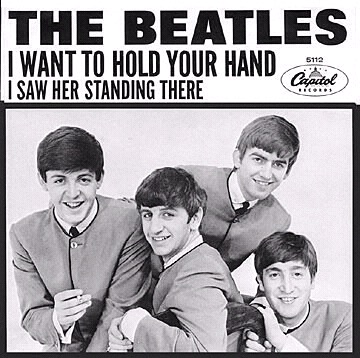
I’d seen picture sleeves on records before.  Some singles by the Beach Boys had them.  There were other groups with picture sleeves as well.  On this day the one that attracted me had on it a black and white photo of four guys in collarless jackets, the guy on the left sporting a lit cigarette in his fingers.  These were the Beatles I’d been seeing on television news and was hearing on the radio.  That sleeve containing their record, I Want To Hold Your Hand, called out to me.


I walked down one aisle after another, record in hand, to find Mom.  If I could just sneak it into the cart unnoticed, I’d nonchalantly slip it on to the conveyor belt at the checkout as I helped unload groceries.  I chickened out and simply asked her if she’d buy it for me.  My reasoning must have been sound.  In 1963, Mom bought me the first Beatles record I ever owned.

Tonight we saw the Ron Howard film, The Beatles: Eight Days a Week – The Touring Years.  The first few minutes of the movie stirred up such a visceral response that I almost pulled out a handkerchief.  My thoughts were drawn back to that day in the Bonnie Bee Supermarket and how Mom gave in to my begging.  Little did she know I’d eventually be asking for an electric guitar.  (I got that too.  Man, I must have been good.)

See the film.  If you’re so moved, post a comment about your first memorable Beatles moment.  And by the way, thanks Mom!

The Beatles: Eight Days a Week – The Touring Years official UK trailer

Put me in, Coach!

September ushers in the end of the regular baseball season.  As the boys of summer begin wrapping it up and the ivy on the outfield walls goes from green to red, we anxiously anticipate playoff games, Pennant winners and the World Series.

I never impressed the girls by playing Little League or high school baseball so I never could place myself in the protagonist role of Bruce Springsteen’s Glory Days, a 1984 song in which the Boss used baseball as the basis for reminiscing and recapturing the spirit of his youth.  In high school I’d chosen instead to play guitar and sing in a rock ‘n’ roll band, like Bruce, but without the baseball connection and with only a fraction of the talent.

  Bruce Springsteen – Glory Days (1984)

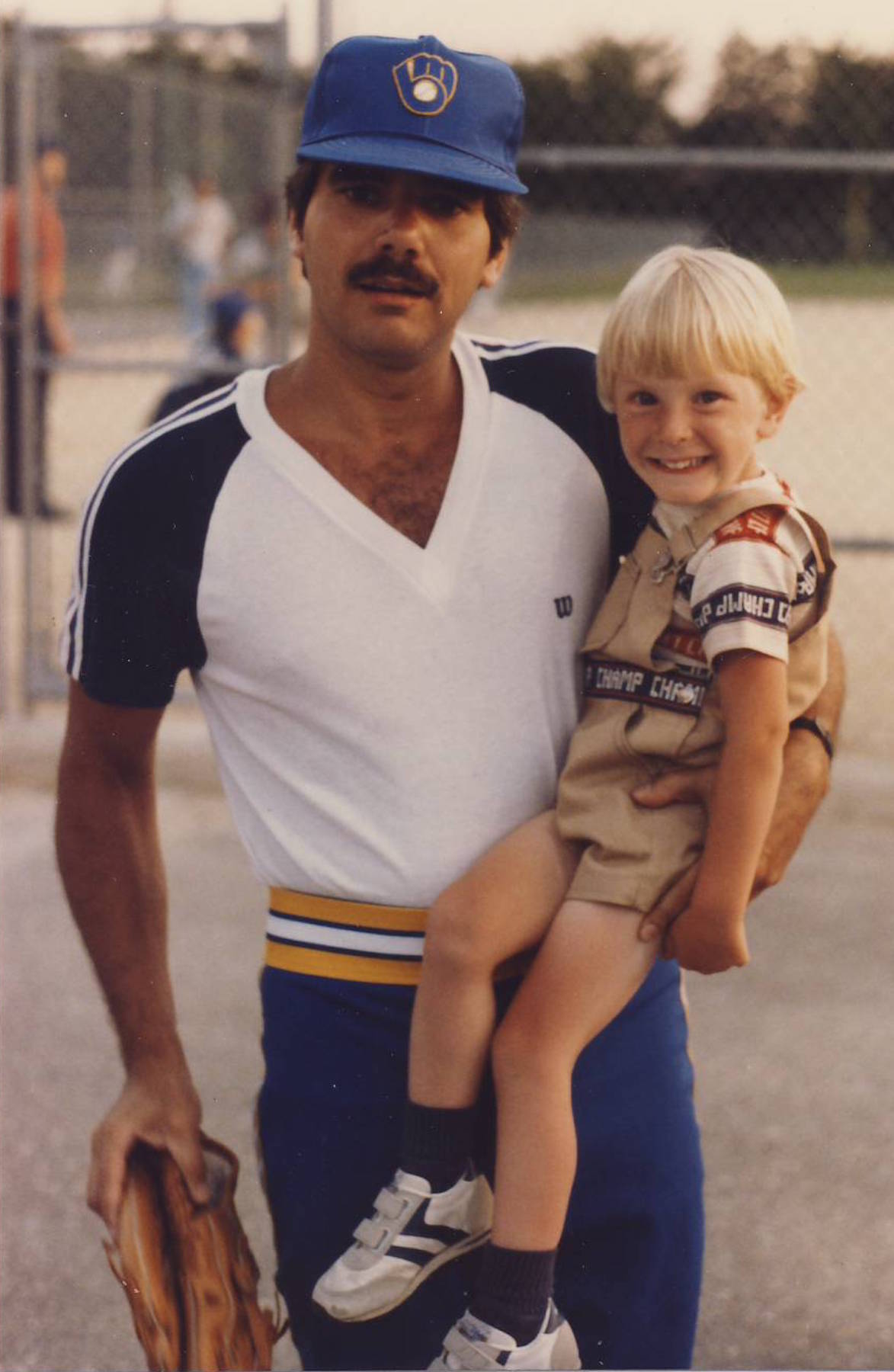
It just might have been Glory Days that inspired me to buy a new baseball glove, oil it up and try out for the City of Janesville’s adult softball league.  It was April 1985, a year after the release of the song and long past high school.  I was director of the Janesville Public Library and had been invited to join the Tramps, a ragtag team comprising journalists from the local newspaper, some who covered the library beat, and a couple of city employees.  It turned out to be the most fun I’d had in years.

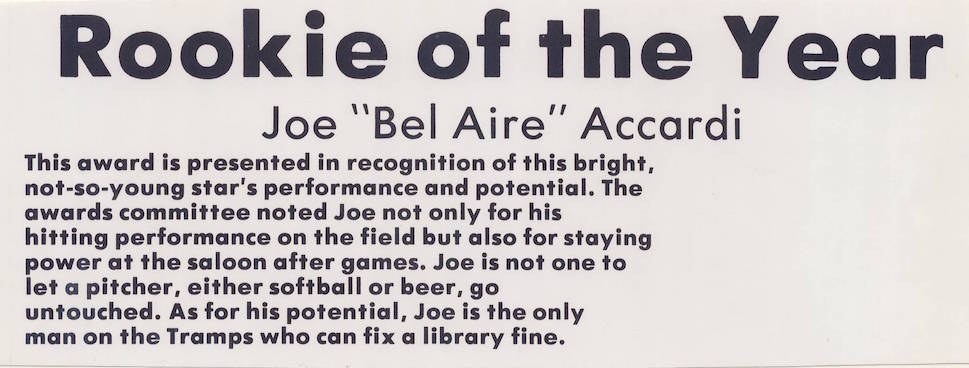
rookie0001That first season with the Tramps, I did well enough to earn a 1985 Rookie of the Year title and receive the coveted pasteup of a mock newspaper article written by the sports editor himself.

softball0001Exhilarated by my successful debut on the diamond, I spent the winter months working out, even taking up jogging during the noon hour instead of eating sandwiches and potato chips.  (I saved those for after jogging.)  By the following spring, I was itching for softball to begin.  Tuesday, April 1, 1986 marked the first scheduled day of softball practice beginning promptly at 4:30 p.m. in the open field between the library and Marshall Junior High School.

I was running late, finishing up a report for the library board.  Closing the office door, I quickly changed into jeans and a sweatshirt, grabbed my glove, donned my cap and headed out the door.  I slipped my cleats on before stepping out on to the soft, wet turf.  The weather had been cloudy and misty all day.  There was a chill in the air which made me grateful to have that sweatshirt.

The guys were already shagging fly balls as I trotted out to center field.  Ironically, I was singing John Fogerty’s 1985 song Centerfield to myself on the way there.  I turned to face the batter who was peppering the outfield with lines drives and grounders.  Then came a fly ball heading just to my right.  I took a few paces toward the spot, planted my right foot in the soft grass and turned.

A loud snap echoed off the building as I crumpled to the ground, shooting stars projected on the inside of my closed eyelids, pain coursing through my leg.  When I finally opened my eyes, faces hovered over mine telling me to “just lie still,” and “the paramedics are on their way.”  The medical crew asked permission to cut open my pant leg so they could examine me.  I could barely speak, so I simply nodded.

injuredI’d torn the anterior cruciate ligament (ACL) inside my right knee along with the miniscus.  Surgery, recovery and rehabilitation replaced softball that summer.  I was, however, able to attend one last game in late July.  It felt good just to sit on the bench with my teammates, even though my leg was immobilized and I still had crutches with me in case I needed them.

On the field, an argument with the home plate umpire resulted in one Tramp being ejected from the game.  Down to a skeleton crew already, the roster now showed only eight Tramps for the bottom of the final inning.  With the Tramps behind by only one run, the game would be forfeited if a ninth player wasn’t named.  I was the only other guy on the bench.  Coach Mike asked if I could just stand at the plate and swing at the ball.  I said, “What the hell?  OK.”

I was on deck when the batter ahead of me popped out.  Hobbling to the batters box, I held a bat and stood there awkwardly for a minute, while the entire defense moved in closer, ready for the easy out.  The pitcher must have felt sorry for me though.  He tossed me a perfect pitch.  Even as I swung gingerly to avoid twisting my knee, aluminum connected with leather in a line drive to the gap in right-center field.  I took off hobbling toward first base where to everyone’s surprise, including my own, I was safe!

Now what do I do?  The guy after me also hit a line drive.  I hobbled toward second base, but before I’d taken five steps he was gaining fast and shouting, “Run!  Run!”  Well, I couldn’t run and he finally realized my predicament when the shortstop tagged second base and then tossed the ball to first where he was declared out.  That was game.  The Tramps lost by a run.  I, on the other hand, recorded a single for my only at-bat that season.

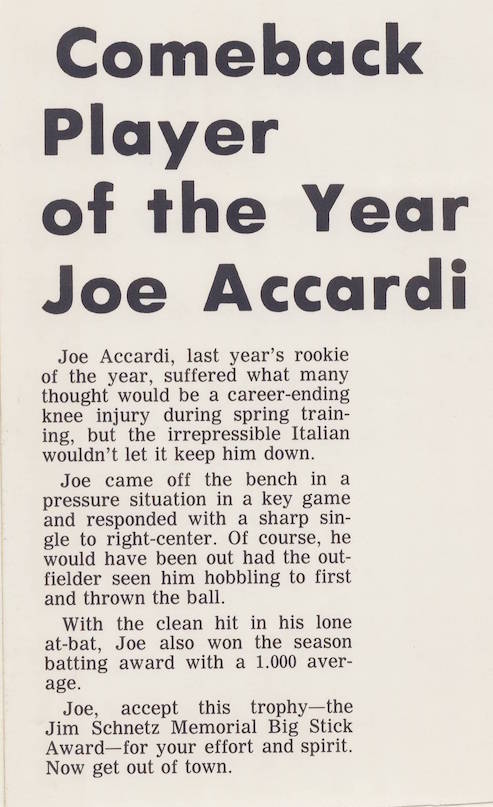
At the fall team dinner, I was awarded a batting trophy, the only team member to have achieved a perfect season hitting record.  “Oh, put me in, Coach.  I’m ready to play, today…”

softball0002 John Fogerty – Centerfield (1985)

Eclipse

And everything under the sun is in tune.  But the sun is eclipsed by the moon.

Surrounded by darkness, an explosion of colors pierced the air as if the northern lights were suddenly and fully ablaze from above.  A mild hallucinogen might have enhanced the experience.  It was no ordinary Eclipse.  That natural phenomenon typically isn’t accompanied by any sounds short of ambient traffic noise or, if you’re lucky, the early evening chirping crickets confused by a sudden onset of dusk.  Or perhaps the ever present chattering of locusts.

No.  It was no ordinary Eclipse.  This Eclipse would be repeated nightly for several weeks or even months.  And it would be accompanied by virtually the same sounds each time.  The wailing of voices.  A steady beat of drums accentuated by an occasional cymbal crash.  A rhythmic shrieking of electric guitars.  The heavy thumping of a bass guitar, along with a sometimes lilting, sometimes bellowing Hammond organ.

This Eclipse emanated from a stage upon which stood four men and one woman among towering stacks of electronic boxes powered by massive watts of amplification. The colored lights from above were among the first of the laser light shows whose wondrous spectacle would only improve over time.  A man made Eclipse to be sure.  In many respects, no less stunning than the natural phenomenon itself.  In both instances, holding a rapt audience in awe. Just as an Eclipse is supposed to do.  Just as Pink Floyd intended it.

There is no dark side of the moon really. Matter of fact it’s all dark.

Pink Floyd – “Eclipse” (Live at Wembley Stadium, 1974)


Irish Eyes

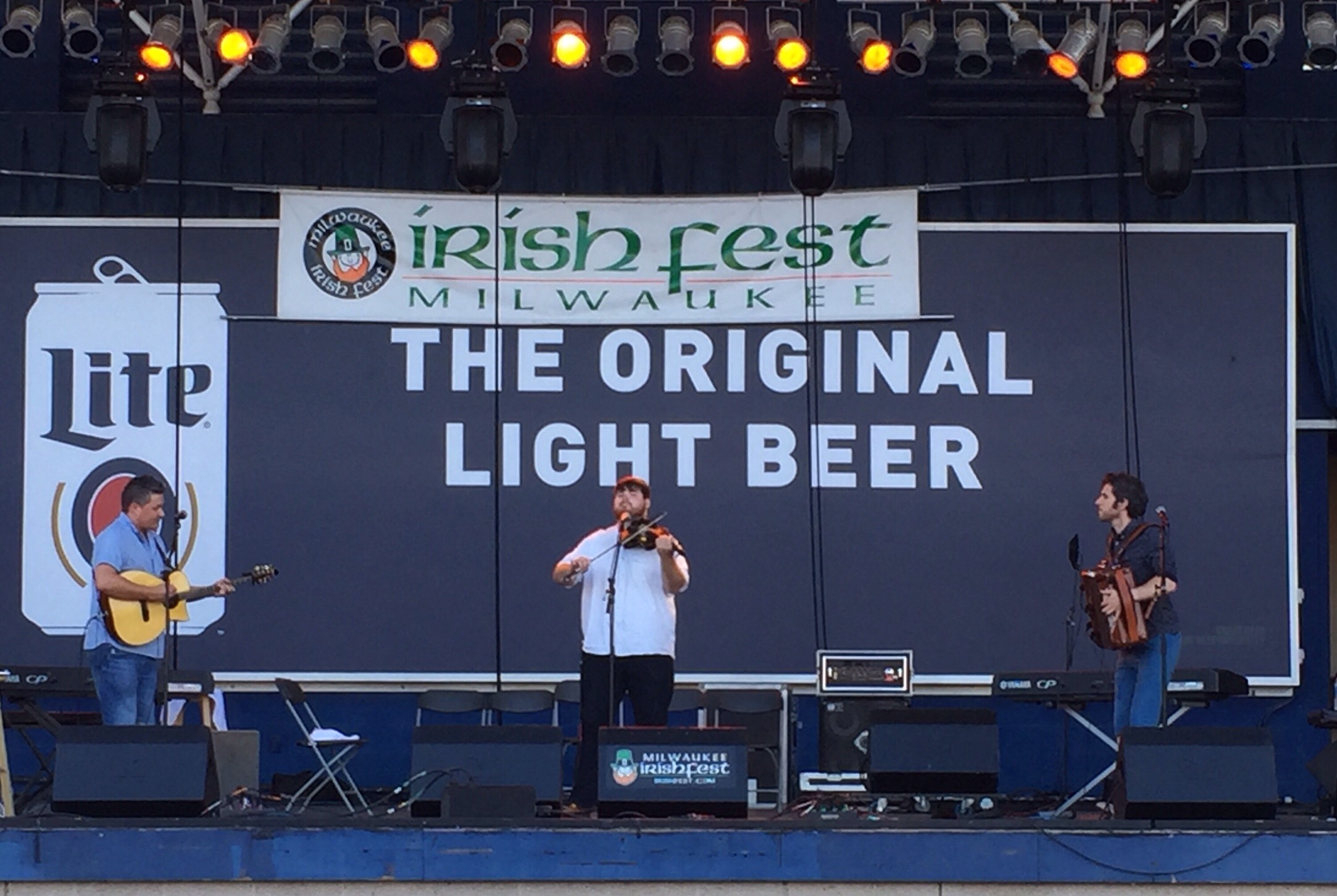
With few exceptions, Sylvia and I among them, it’s all Irish eyes at Milwaukee’s Irish Fest this weekend. We accompanied my former Notre Dame classmate and Irish pal Frank to opening night .  Thursday evening’s preview session stepped off with newcomers to the festival, Barrule, a trio from the Isle of Man comprised of bouzouki, fiddle and accordion.  Their blend of Manx jigs, reels and songs provided a pleasant opening to this celebration of Celtic music and culture.

Barrule

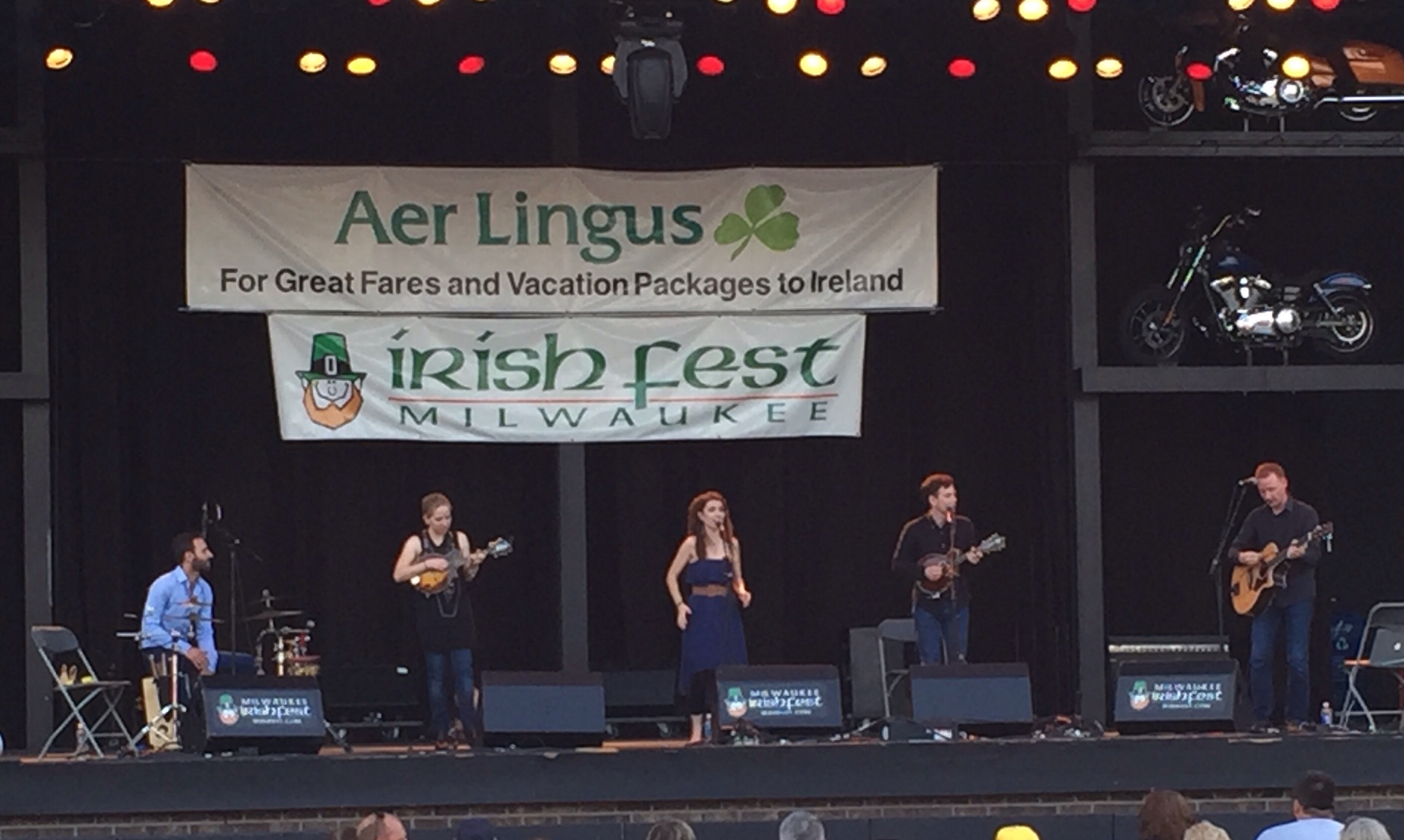
Another new band at the fest is Runa, in whose blend of traditional roots music and contemporary Irish folk songs we heard hints of bluegrass, jazz and blues.  When They deftly wove verses of My Girl into a Gaelic song, the audience responded with even greater enthusiasm.  We’ll definitely hear more from Runa as we seek out their extended performances over the weekend.

Runa

A longtime favorite, whose appearance marks their 20th anniversary on tour, is Solas.  I first heard Solas on the radio some years ago. Their haunting cover of Jesse Colin Young’s Darkness, Darkness sent shivers down my spine and the rest of their preview performance last night exceeded my expectations, blending both traditional Celtic music and contemporary original compositions.   I’ll be seeking out more Solas during the remaining days of the festival…

Solas

…and I’ll be keeping my eyes (and ears) peeled for more great performances like these.

Fun with Electronic Music

A few evenings ago I was sitting in the garage, settled into one of those folding camp chairs, enjoying the warm summer evening and sipping from a bottle of cold, locally crafted beer.   A white Chevrolet drove slowly by.  As it passed, I could hear some pounding drum beat accompanying electronic music.  The car pulled into a parking space around the corner from where I was sitting. A young couple on their way home from work got out and walked past me.  As we glanced at each other, I asked them who I’d just heard coming from their car stereo.

They stopped, and just for a second I’m almost certain they thought I was just some “get off my lawn” grumpy old man who was about to give them crap about their loud music.  Just as quickly they realized that wasn’t the case and that I was really interested in whose music I’d heard.  Smiling, they responded “Alice in Wonderland.”  That’s what I thought they said, but the quizzical look on my face only served to broaden their smiles as they spelled it out, “A-l-i-s-o-n” Wonderland.  I thanked them and they continued their walk home.

The Internet is a wonderful tool for researching a name in the music world.  I already had my tablet with me in the camp chair, just starting on a collection of Ernest Hemingway’s short stories I’d downloaded earlier that day.  Hemingway would have to wait.  Instead I Googled “Alison Wonderland.”

Alison Wonderland, whose given name is Alex Sholler,  is an Australian-born “DJ,” a disc jockey in its truest form.  Otherwise known as a turntablist, Alison is a musician who mixes music and sounds to create electronic dance music (EDM) or “trip hop.”  Regardless of what label it goes by, it sounded pretty good to me, so I checked out some clips of her work.  This clip is from her track called “Run,” released in 2015:

(Alison Wonderland – “Run” [clip])

Some time ago I might have mentioned the first album of electronic music I bought way back when I was in high school.  It was the eponymously titled Silver Apples.  Here’s a clip from the opening track, “Oscillations,” released in 1968:

(Silver Apples – “Oscillations” [clip])

No one I can recall in 1968 ever referred to this as electronic dance music.  In fact, it would be impolite for me to repeat what some of my friends called it back then.  In spite of my half-hearted insistence that it was really worth a listen, my plea fell mostly on deaf ears.  It certainly wasn’t anything to which we felt compelled to dance along.  Today, if I was a DJ, I’d slip a little Silver Apples into my dance mix just to see if anyone would notice.  It just might sound like this:

(Alison Apples – Runscillation [mix clip])

Makes you wonder if Thomas Edison and the pioneers of volts, watts and amps ever imagined dancing to the blips and beeps they discovered.  I suspect they’d be blown away for sure.